
Dubai Construction Work & Overseas Jobs Master Guide 2026: Salaries (AED & INR), 25+ Trades, UAE Labour Law (Decree-Law 33/2021), MOHRE Employment Visa Roadmap, WPS & Camp Living
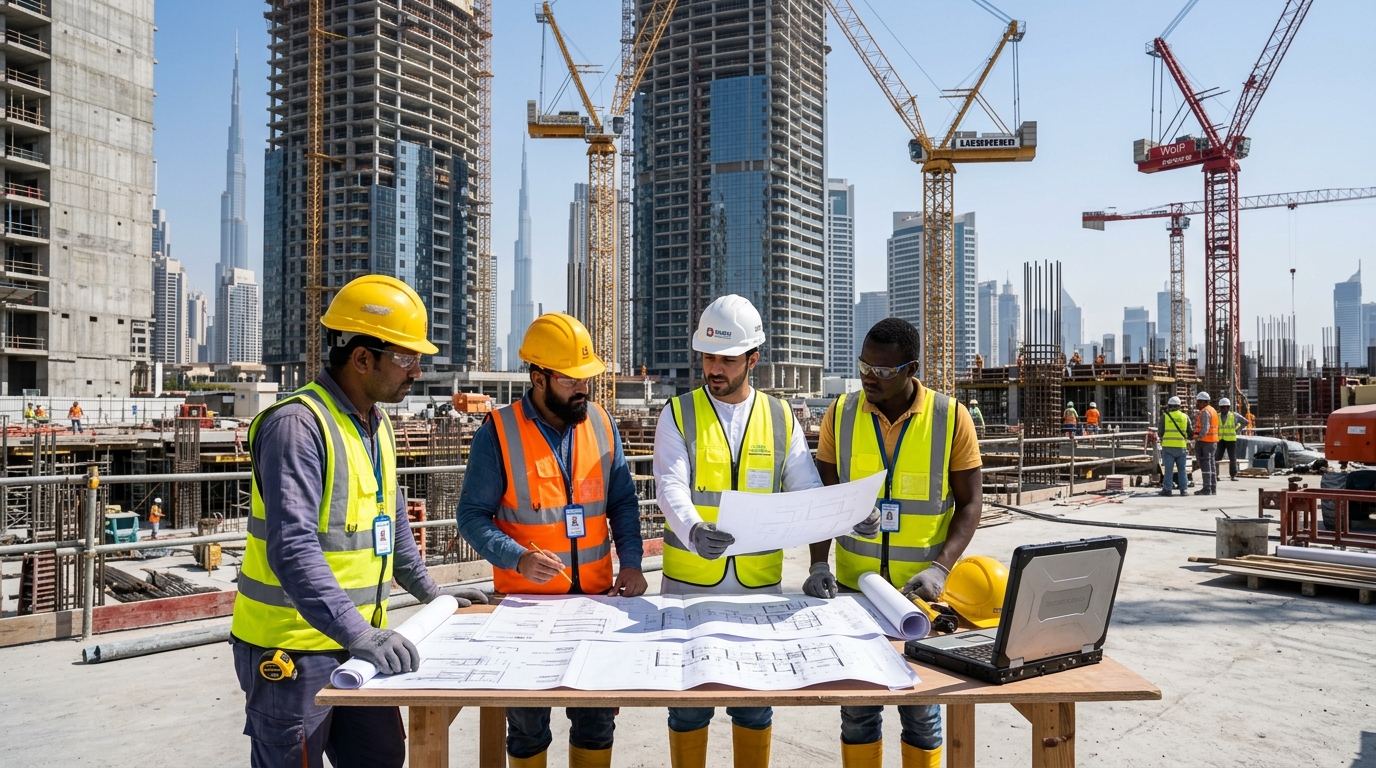
Comprehensive guide to Dubai construction work for Indian and overseas tradesmen. Complete breakdown of 25+ trades, verified salary matrices in AED & INR, UAE Labour Law (Decree-Law 33/2021), Midday Work Ban, End-of-Service Gratuity, 6-phase employment visa roadmap, GAMCA medicals, eMigrate ECR clearance, labour camp living (Sonapur, Al Quoz, Jebel Ali), safety protocols, top Tier-1 contractors (AFGC Holding, ALEC, ASGC, Shapoorji, Six Construct), and fraud prevention.
Dubai Construction Work & Overseas Jobs Master Guide 2026: Salaries (AED & INR), 25+ Trades, UAE Labour Law (Decree-Law 33/2021), MOHRE Employment Visa Roadmap, WPS & Camp Living
The skyline of Dubai stands as one of the most remarkable architectural achievements in human history. Over the past four decades, a sun-drenched coastal trading port has transformed into a hyper-modern global metropolis characterized by record-breaking skyscrapers, human-made archipelagos, world-class road networks, and futuristic transit systems. Yet behind every shimmering glass facade of the Burj Khalifa, every suspension cable of the Dubai Water Canal footbridges, and every cavernous terminal concourse of Dubai International Airport lies an enduring, indispensable reality: the dedication, resilience, and specialized craftsmanship of millions of international construction workers.
For decades, blue-collar tradesmen, technicians, and engineering operatives from India (particularly the states of Uttar Pradesh, Bihar, Rajasthan, Punjab, Kerala, and Tamil Nadu), Pakistan, Bangladesh, and Nepal have made the journey to the United Arab Emirates. For these workers, overseas construction employment represents far more than a monthly paycheck; it is an economic lifeline that builds family homes back in rural villages, funds higher education for younger siblings, finances weddings, clears multi-generational debts, and establishes long-term financial security.
As we navigate 2026, the construction landscape across the Emirate of Dubai is not slowing down; rather, it is experiencing an unprecedented structural super-cycle driven by national strategic agendas, unprecedented population growth, and visionary infrastructure commitments. Under the framework of the Dubai Economic Agenda (D33) and the visionary Dubai 2040 Urban Master Plan, the Government of Dubai is actively investing hundreds of billions of dirhams to double the size of the emirate's economy, expand residential capacity, and upgrade civic infrastructure to accommodate a permanent resident population projected to surge from 3.6 million to over 5.8 million people.
1. The Macro Reality & The $150 Billion Dubai Construction Super-Cycle (2026–2040)
To understand the sheer magnitude of employment opportunities available today, prospective candidates and overseas recruitment stakeholders must examine the macroeconomic engines powering Dubai's current infrastructure boom. Unlike previous speculative real estate cycles, the 2026 construction wave is anchored by state-backed sovereign financing, strategic multimodal transport corridors, sustainable urban regeneration projects, and major aviation expansions.
Strategic Megaprojects Fueling Unprecedented Labor Demand
- Al Maktoum International Airport (DWC) Mega-Expansion ($35 Billion USD / AED 128 Billion):
Announced as the single largest aviation infrastructure undertaking on earth, the expansion of Al Maktoum International Airport at Dubai South spans an astonishing 70 square kilometers. Upon phased completion, DWC will feature 400 aircraft gates, five parallel runways operating simultaneously, and the capacity to handle up to 260 million passengers and 12 million tonnes of cargo annually. The sheer scale of civil excavation, concrete casting, structural steel erection, MEP installations, and runway paving required for DWC has triggered an immediate demand for over 80,000 skilled and semi-skilled construction personnel.
- The Dubai Metro Blue Line ($5 Billion USD / AED 18 Billion):
Expanding Dubai's renowned mass transit network, the 30-kilometer Blue Line connects key population centers including Dubai Creek Harbour, Dubai Silicon Oasis, Academic City, Ras Al Khor, and International City with existing Red and Green lines. Featuring 14 state-of-the-art stations (nine elevated and five deep underground subway stations) and spanning two dramatic rail bridges across Dubai Creek, this project requires massive deployments of tunnel boring machine (TBM) operators, underground shuttering carpenters, rebar fabricators, railway track alignment specialists, and high-voltage traction substation electricians.
- Palm Jebel Ali & Dubai Islands Coastal Developments:
Twice the size of the iconic Palm Jumeirah, Palm Jebel Ali has been reactivated with billions in infrastructure tenders covering marine dredging, coastal revetments, seawall construction, luxury villa foundations, and deep utility trenching. Concurrently, Dubai Islands (formerly Deira Islands) is adding over 20 kilometers of new beachfront, dozens of luxury hotel resorts, and commercial marinas, generating extensive civil and MEP employment.
- Super-Tall Skyscraper Resumptions & Next-Generation High-Rises:
Dubai continues to dominate the global skyscraper index. Iconic developments such as the redesigned Dubai Creek Tower, Burj Binghatti Jacob & Co Residences (aiming to be the world's tallest residential crown), Burj Azizi on Sheikh Zayed Road (surpassing 700 meters), and dozens of ultra-luxury residential towers in Business Bay, Downtown Dubai, and Dubai Marina are operating 24 hours a day on multi-shift schedules.
| Megaproject Name | Project Type & Scope | Estimated Budget | Target Horizon | Peak Workforce Demand |
|---|---|---|---|---|
| Al Maktoum International Airport (DWC) | Mega-Aviation Hub, 5 Runways, 400 Gates | AED 128 Billion ($35B USD) | 2026 – 2034 | 85,000+ Workers |
| Dubai Metro Blue Line | 30 km Rail Transit (14 Underground & Elevated Stations) | AED 18 Billion ($4.9B USD) | 2026 – 2029 | 22,000+ Workers |
| Palm Jebel Ali Infrastructure | Coastal Land Reclamation, Villas, Utilities & Bridges | AED 30+ Billion ($8.2B USD) | 2026 – 2032 | 35,000+ Workers |
| Dubai Creek Tower & Harbour District | Supertall Landmark & Mixed-Use Waterfront City | AED 25 Billion ($6.8B USD) | 2026 – 2030 | 30,000+ Workers |
| Dubai 2040 Green Urban Corridors | Cycling Highways, Canal Expansions, Public Parks | AED 12 Billion ($3.3B USD) | 2026 – 2040 | 18,000+ Workers |
| Residential Towers (Business Bay & Marina) | 140+ High-Rise Commercial & Residential Towers | AED 45+ Billion ($12.2B USD) | Continuous | 60,000+ Workers |
This colossal volume of construction activity has created an urgent, structural labor shortage across the United Arab Emirates. However, modern construction in Dubai is governed by sophisticated engineering standards, computerized project management systems, stringent health and safety codes, and rigorous regulatory oversight by the Ministry of Human Resources and Emiratisation (MOHRE). For an aspiring worker or technician, success requires an exact understanding of trade classifications, legal protections, wage entitlements, safety norms, and direct government-authorized recruitment channels.
2. The Definitive 25+ Construction Trades Directory
Construction sites in the UAE are organized into disciplined, highly coordinated operational divisions. Every trade performs a vital link in the construction chain. Below is an exhaustive operational profile of the top 26 construction trades actively hired across Dubai, including core duties, required tool competencies, skill benchmarks, and typical site responsibilities.
Civil & Structural Trades
1. Construction Helper / Unskilled Laborer
- Core Operational Duties: The construction helper is the essential foundation of any job site. Helpers are responsible for transporting raw materials (cement bags, sand aggregates, AAC blocks, scaffold pipes, rebar bundles) from staging yards to active work faces. They assist master craftsmen by mixing mortar, operating portable concrete mixers, handling concrete vibrator needles during pours, clearing formwork debris, maintaining site housekeeping, and ensuring clean work areas to prevent tripping hazards.
- Tools & Equipment Handled: Wheelbarrows, shovels, pickaxes, sledgehammers, hand scrapers, water curing hoses, needle vibrators, manual hoists, and material trolleys.
- Skill Requirements & Progression: No formal academic qualifications are required. Must possess physical stamina, heat endurance, basic safety awareness, and the ability to follow safety instructions. With on-the-job dedication, an active helper can quickly learn masonry, shuttering carpentry, or steel fixing within 12 to 18 months, doubling their earning potential.
2. Mason (Block, Plaster, Tile, Marble & Interlock)
- Core Operational Duties: Masons are categorized into structural and finishing specialists:
- Block Masons: Lay Autoclaved Aerated Concrete (AAC) blocks, hollow concrete blocks, and thermal lightweight blocks using precise mortar lines, checking horizontal and vertical alignments with spirit levels and plumb bobs.
- Plaster Masons: Apply internal gypsum plaster and external cement-sand plaster coats on blockwork and concrete surfaces, using chicken mesh at concrete-block junctions to prevent structural cracking.
- Tile & Marble Masons: Install ceramic, vitrified, porcelain, and natural granite/marble tiles across floors, bathrooms, and corridors using tile spacers, laser levels, waterproof adhesives, and non-shrink grouting compounds.
- Interlock Masons: Level sand sub-bases and lay interlocking pavers for pedestrian pavements, driveways, and road walkways.
- Tools Handled: Trowels, spirit levels, plumb bobs, rubber mallets, electric tile cutters, angle grinders, aluminum straightedges, notched trowels, and laser levels.
- Skill Benchmarks: Knowledge of mortar mixing ratios (1:3 for plaster, 1:4 for blockwork), surface leveling tolerances (under 2mm deviation over a 2-meter straightedge), and wet area waterproofing protection.
3. Shuttering Carpenter (Formwork Specialist)
- Core Operational Duties: Shuttering carpenters fabricate, assemble, and erect the temporary timber and steel formwork moulds into which wet concrete is poured. They build moulds for footings, raft foundations, retaining walls, heavy load-bearing columns, shear walls, elevator cores, beams, and suspended floor slabs.
- Formwork Systems Handled: Traditional timber formwork (marine plywood, timber runners, H20 timber beams, Acrow steel props) and engineered modular systems including Doka, PERI, Meva, and aluminum formwork (Mivan systems).
- Key Responsibilities: Interpreting structural formwork shop drawings, ensuring vertical plumbness using heavy optical plumb lines, securing tie-rods with wing nuts, applying release oil, and carrying out safe formwork stripping (deshuttering) after concrete reaches specified compressive strength without damaging edges.
4. Steel Fixer / Barbender
- Core Operational Duties: Steel fixers read engineering Bar Bending Schedules (BBS) to cut, bend, position, and tie structural steel reinforcement bars (rebar) that give reinforced concrete its tensile strength.
- Key Responsibilities: Laying bottom and top reinforcement mats for raft foundations; assembling column cages with main longitudinal bars and helical/lateral ties (stirrups); positioning beam reinforcement cages with spacer blocks to maintain cover; tying rebar intersections securely using 16-gauge black annealed binding wire and tying pliers; and coordinating duct placement for Post-Tensioned (PT) concrete slabs.
- Tools Handled: Manual and hydraulic rebar bending machines, mechanical rebar cutters, tying pliers, measuring tapes, chalk line markers, and rebar positioning hooks.
5. Scaffolder (Erection & Dismantling Operative)
- Core Operational Duties: Scaffolders erect, modify, and dismantle safe temporary elevated working platforms and access towers for trades working at heights.
- Systems Handled: Cuplock Scaffolding, Kwikstage, modular ring-lock systems, and traditional tube-and-coupler scaffolding.
- Safety Benchmarks: Laying timber sole boards and base plates on compacted ground; installing vertical standards, horizontal ledgers, diagonal braces, transom members, toe boards, and double-tier guard rails (top rail at 1.0m, mid-rail at 0.5m); securing wall ties to the permanent concrete structure; and hoisting the mandatory green safety tag (Safe to Use) after inspection by a certified scaffold supervisor.
6. Painter (Commercial, Residential & Exterior Texture)
- Core Operational Duties: Prepares internal and external surfaces of buildings for decorative and protective paint applications.
- Key Responsibilities: Surface preparation including scraping, wire-brushing, sanding, and applying alkali-resistant primer; applying multiple coats of wall putty with skim coats to achieve a mirror-smooth finish; applying interior emulsion paints via rollers and brushes; operating commercial airless spray painting rigs for vast warehouse ceilings; and applying weather-resistant exterior textured coatings (Jotun, Dulux, National Paints) and elastomeric waterproof coatings on facade walls.
7. Gypsum Carpenter / Drywall & False Ceiling Fixer
- Core Operational Duties: Installs lightweight drywall partition systems and suspended false ceilings across luxury apartments, office complexes, shopping malls, and hotel guestrooms.
- Key Responsibilities: Layout marking using 360-degree cross-line laser levels; installing galvanized steel floor tracks, vertical wall studs, acoustic insulation batts (rock wool), and moisture-resistant gypsum boards (green board for bathrooms, pink board for fire-rated walls); fixing perimeter ceiling trims, main carrying channels, and furring channels; screwing gypsum ceiling boards; and applying fiber tape and joint compound with feather-edge trowels for seamless paint finishing.
8. Concrete Pump Operator & Power Float Finisher
- Core Operational Duties: Directs and controls the delivery of ready-mix concrete from transit mixers into building formwork using mobile truck-mounted boom pumps (up to 62 meters) and stationary high-pressure trailer pumps connected to vertical delivery pipelines on high-rise towers.
- Finishing Operatives: Operate mechanical walk-behind and ride-on power floats (trowelling machines) on fresh concrete slabs to compact surface aggregate, eliminate air voids, and achieve a glass-smooth or non-slip broomed industrial warehouse finish.
Mechanical, Electrical & Plumbing (MEP) Trades
9. Construction Electrician (Conduit, Cable & Termination)
- Core Operational Duties: Installs the complete electrical distribution backbone of residential, commercial, and industrial structures in strict compliance with the Dubai Electricity and Water Authority (DEWA) regulations.
- Key Responsibilities: Chasing walls and embedding rigid PVC electrical conduits before plastering; installing galvanised iron (GI) conduits in exposed ceiling voids; fabricating and fixing heavy-duty perforated cable trays, ladders, and trunking networks; pulling low-voltage power cables (single-core and multi-core armoured cables); dressing Distribution Boards (DB), Sub-Main Distribution Boards (SMDB), and Main Distribution Boards (MDB); terminating wires into circuit breakers (MCBs, RCCBs, MCCBs); and installing switches, sockets, smart home automation sensors, and LED lighting fixtures.
10. Plumber & Drainage Pipefitter
- Core Operational Duties: Installs internal and underground sanitary drainage systems, rainwater drainage, and pressurized potable domestic water supply piping in compliance with Dubai Municipality plumbing standards.
- Key Responsibilities: Solvent-welding and mechanical coupling of UPVC and HDPE acoustic drainage pipes; electrofusion and butt-welding of high-density polyethylene (HDPE) underground sewer mains; heat fusion welding of Polypropylene Random Copolymer (PPR) and PEX piping for hot and cold pressurized domestic water supply; installing bathroom concealed valves, wall-hung WC frames (Geberit systems), basin mixers, and drainage floor traps; and conducting hydrostatic pressure testing at 10 to 15 bar to verify zero leakage.
11. HVAC Ductman & Sheet Metal Fabricator
- Core Operational Duties: Fabricates, measures, installs, and insulates galvanized iron (GI) and pre-insulated aluminum air conditioning ductwork networks that distribute chilled air from Air Handling Units (AHU) and Fan Coil Units (FCU).
- Key Responsibilities: Assembling rectangular and spiral round sheet metal duct segments using drive cleats, S-cleats, and TDC/TDF flange connections; mounting seismic duct hangers and spring isolators; installing motorized volume control dampers (VCD), fire dampers, and sound attenuators; applying thermal acoustic insulation; connecting flexible duct connectors to terminal supply and return air diffusers; and conducting smoke leakage testing.
12. Thermal & Acoustic Insulator (Pipe & Duct Cladding)
- Core Operational Duties: Applies specialized thermal insulation materials around chilled water pipes, refrigerant copper lines, domestic hot water pipes, and air conditioning ducts to prevent condensation, minimize thermal energy loss, and resist external desert heat.
- Materials Handled: Closed-cell elastomeric nitrile rubber foams (Armaflex, K-Flex), rock mineral wool blankets, and rigid polyurethane/polyisocyanurate (PIR) pipe sections.
- Finishing Skills: Fabricating and fixing protective aluminum, stainless steel, or Polyisobutylene (PIB) weatherproofing jackets (cladding) around exposed outdoor roof piping, executing precision bends, valve boxes, and tee-junction elbows.
13. Firefighting Pipefitter & Sprinkler Technician
- Core Operational Duties: Installs critical life-safety fire protection networks in strict conformity with Dubai Civil Defence (DCD) regulations and NFPA standards.
- Key Responsibilities: Fabricating and erecting heavy Schedule 40 seamless black carbon steel piping; cutting and roll-grooving pipe ends using motorized grooving machines; assembling mechanical grooved couplings (Victaulic connections); threading small-bore steel pipes; installing upright and pendant automatic fire sprinkler heads; mounting landing valves, fire hose reel cabinets, breeching inlets, and Zone Control Valves (ZCV) with flow switches and tamper-monitored valves; and conducting hydrostatic testing at 200 psi for 24 hours.
14. High-Voltage / Low-Voltage Cable Jointer
- Core Operational Duties: Executes precision jointing, straight through-connections, and end terminations of high-voltage (11kV and 33kV) and low-voltage (1kV) cross-linked polyethylene (XLPE) insulated and paper-insulated lead-covered (PILC) power cables.
- Key Responsibilities: Stripping outer protective sheaths without nicking semiconductor layers; applying heat-shrinkable or cold-shrinkable stress control sleeves; installing heavy copper compression lugs using hydraulic crimping tools; bolting connections into oil-immersed or dry-type 11kV transformers, Ring Main Units (RMU), and switchgear panels; and performing insulation resistance (Megger) and High-Potential (Hi-Pot) electrical safety tests.
Welding, Fabrication & Heavy Machinery Trades
15. 6G & 3G Welder (SMAW, TIG & MIG Specialist)
- Core Operational Duties: Performs certified high-integrity fusion welding on pressurized piping systems, industrial power plants, district cooling plants, and primary structural steel frameworks.
- Positions & Processes:
- 6G Welder: Qualified to weld pipe in the 6G position (pipe fixed at a 45-degree angle without rotation), demonstrating mastery of all welding positions (overhead, horizontal, vertical). Utilizes GTAW (TIG) for the initial penetration root pass and SMAW (Stick) or GMAW (MIG) for hot passes, filler passes, and capping passes.
- 3G Welder: Qualified for vertical structural plate welding in uphand progression.
- Quality Benchmarks: All welded joints must pass 100% Visual Inspection (VT), Liquid Penetrant Testing (PT), Magnetic Particle Testing (MT), and Non-Destructive Ultrasonic (UT) or Radiographic X-Ray Testing (RT) without porosity, slag inclusions, lack of fusion, or root undercut.
16. Structural Steel Fabricator & Erector
- Core Operational Duties: Fabricates, aligns, and erects heavy structural steel building columns, trusses, rafter beams, and space frames for aircraft hangars, logistics warehouses, exhibition centers, and high-rise core structures.
- Key Responsibilities: Reading detailed structural steel fabrication drawings; operating magnetic base core drills, oxygen-acetylene cutting torches, and plasma cutters; aligning base plates over anchor bolts embedded in concrete foundations; guiding mobile cranes to lift massive steel beams into position; installing high-strength friction-grip (HSFG) structural bolts; and tightening bolts to specified torque values using calibrated torque wrenches.
17. Tower Crane Operator
- Core Operational Duties: Operates high-capacity saddle-jib, luffing-jib, and self-erecting tower cranes anchored to the exterior or rising through the internal elevator shafts of supertall skyscrapers at altitudes ranging from 80 meters to over 450 meters.
- Key Responsibilities: Performing daily pre-operational hoist brake, trolley, slew ring, and load moment limiter (LML) inspections; calculating load charts against boom radius; executing precision vertical lifting and placement of concrete skips, heavy formwork shutters, steel rebar bundles, and precast facade panels; communicating continuously with site banksmen via UHF two-way radio channels; and monitoring anemometers to immediately halt crane operations whenever wind speeds exceed safe statutory limits (typically 38 km/h or 20 knots).
18. Mobile Crane Operator (50-Tonne to 500-Tonne)
- Core Operational Duties: Operates all-terrain, rough-terrain, and heavy crawler cranes for heavy industrial lifting, precast bridge girder installation, modular chiller positioning, and civil equipment loading.
- Key Responsibilities: Inspecting ground soil bearing capacity; supervising the deployment of hydraulic outriggers and heavy timber/steel outrigger pads; configuring boom extensions, fly jibs, and counterweight slabs; coordinating tandem crane lifts with certified rigging engineers; and navigating busy public highway corridors under Dubai Police escort permits.
19. Heavy Equipment Operator (Excavator, JCB, Bulldozer, Wheel Loader, Bobcat)
- Core Operational Duties: Operates heavy diesel earthmoving machinery across mass excavation, marine reclamation, infrastructure trenching, and road grading sites.
- Excavator Operator: Operates 20T to 50T tracked hydraulic excavators equipped with rock breakers and digging buckets for deep basement excavations, foundation trenches, and marine rock revetments.
- JCB (Backhoe Loader) Operator: Performs dual-purpose trenching, backfilling, and utility pipe loading in tight urban quarters.
- Bulldozer & Grader Operator: Spreads structural road base, gravel sub-base, and executes laser-guided final road grading.
- Skid Steer (Bobcat) Operator: Highly maneuverable handling of interior demolition debris, material shifting within basement floors, and landscape preparation.
- Certifications: Must hold a valid UAE Category 7 Heavy Mechanical Equipment driving license and third-party competency safety certification.
20. Certified Rigger (Level 1, Level 2, Level 3)
- Core Operational Duties: Directs, rigs, hitches, and coordinates all safe lifting operations between crane operators and ground installation crews.
- Key Responsibilities: Inspecting lifting gear (polyester webbing slings, wire rope slings, grade-80 chain slings, bow shackles, eye bolts, lifting beams) prior to every hoist; calculating center of gravity and sling tension angles; applying appropriate hitch configurations (choker hitch, basket hitch, vertical hitch); attaching tag lines to stabilize swinging loads in desert wind gusts; and directing crane movements using standard international hand and whistle signals.
21. Heavy Bus & Flatbed Trailer Driver
- Core Operational Duties: Serves as the critical transportation link between remote worker residential cities (Sonapur, Al Quoz, Jebel Ali) and active construction sites across the emirate.
- Key Responsibilities: Safely operating 66-passenger air-conditioned worker transport buses through dense highway traffic corridors (Sheikh Zayed Road, Al Khail Road, Emirates Road); adhering to Dubai Roads and Transport Authority (RTA) maximum speed governors (80 km/h for heavy buses); managing flatbed multi-axle trailers transporting heavy precast concrete wall panels, long structural steel trusses, and earthmoving machinery; and conducting mandatory daily tire pressure, air brake reservoir, and radiator coolant checks.
- Certifications: Valid UAE Driving License Category 6 (Heavy Bus) or Category 4 (Heavy Articulated Truck).
Supervisory, Quality & Engineering Support Trades
22. Civil / MEP Chargehand (Gang Leader)
- Core Operational Duties: Acts as the primary frontline link between site management and the operational workforce. A chargehand directly leads a specific gang of 6 to 12 tradesmen and helpers (e.g., Shuttering Gang, Steel Gang, Concreting Gang, Cable Pulling Gang).
- Key Responsibilities: Translating daily work targets assigned by the site foreman into actionable tasks; distributing appropriate tools and consumables; ensuring that all gang members wear required PPE; demonstrating correct craftsmanship techniques; resolving minor on-site layout discrepancies; and reporting finished task quantities at the end of each shift.
23. Site Foreman (Civil, Electrical, Mechanical)
- Core Operational Duties: Oversees multiple work zones or entire structural levels of a building. Responsible for site execution, workforce productivity, inter-trade coordination, and schedule adherence.
- Key Responsibilities: Reading and interpreting architectural, structural, and MEP shop drawings; coordinating work sequencing between civil contractors and MEP subcontractors to avoid pipe-conduit clashes; preparing daily labor and material requisitions; conducting morning Tool Box Talks (TBT); coordinating with the consultant's inspection team for Work Inspection Requests (WIR); and ensuring full compliance with project baseline schedules.
24. Health, Safety & Environment (HSE) Officer
- Core Operational Duties: Enforces zero-harm safety standards across the job site in strict accordance with the Dubai Municipality Code of Construction Safety Practice and UAE Federal Occupational Safety Regulations.
- Key Responsibilities: Preparing and enforcing site-specific Health & Safety Plans (HSP), Risk Assessments, and Job Safety Analyses (JSA); conducting daily site safety inspections; issuing Permit to Work (PTW) documents for high-risk operations (working at heights, confined space entry, hot works, deep trenching, heavy lifting); monitoring ambient Heat Index and Thermal Work Limit (TWL) values during hot seasons; delivering daily safety inductions to new workers; and investigating all near-misses and workplace incidents.
- Qualifications: Internationally recognized certifications such as NEBOSH International General Certificate (IGC), IOSH Managing Safely, or OSHA 30-Hour Construction Safety.
25. Land Surveyor (Total Station & GNSS Specialist)
- Core Operational Duties: Establishes geometric survey control points, boundary lines, vertical alignments, and structural grids across the building site using advanced optical and satellite positioning technology.
- Key Responsibilities: Setting up high-precision electronic Total Stations (Leica, Trimble, Topcon) and Real-Time Kinematic (RTK) GNSS GPS receivers; transferring official Dubai Municipality survey control benchmarks to site monuments; marking column centers, wall grids, anchor bolt locations, and excavation boundary stakes; conducting verticality checks on high-rise elevator cores and facade cladding rails; and compiling as-built survey drawings for municipal completion approvals.
26. QA/QC Inspector (Civil / MEP / Welding)
- Core Operational Duties: Ensures that all construction materials delivered to site and all executed works strictly satisfy project specifications, international engineering standards (BS, ASTM, DIN, ISO), and approved Method Statements.
- Key Responsibilities: Conducting Material Inspection Requests (MIR) upon delivery of rebar, cement, pipes, and fittings; overseeing concrete sampling, slump cone testing, and temperature verification at the batching plant transit truck; witnessing concrete test cube curing and 7-day/28-day compressive crushing tests in third-party laboratories; inspecting formwork alignment, rebar cover, and cleanliness before concrete pours; issuing internal Non-Conformance Reports (NCR) for defective workmanship; and securing final client and consultant approvals.
3. The Complete 2026 Dubai Salary Matrix in AED and Indian Rupee (INR)
Salary transparency is critical when considering overseas construction employment. Construction salaries in the UAE are paid in United Arab Emirates Dirham (AED). The AED is officially pegged to the US Dollar at a fixed rate of $1 USD = 3.6725 AED. When converted to the Indian Rupee (INR), the exchange rate generally fluctuates between ₹22.50 and ₹23.00 INR per 1 AED (benchmarked here at a standard conservative conversion of 1 AED = ₹22.80 INR).
Comprehensive 2026 Dubai Construction Compensation Benchmarks
The figures below represent realistic, verified payroll standards across reputable Tier-1, Tier-2, and major contracting companies in Dubai (e.g., AFGC Holding, ALEC, ASGC, Shapoorji Pallonji, Six Construct, CSCEC). The table includes basic pay, performance/attendance bonuses, standard daily overtime (2 to 3 hours), total gross earnings in AED, and monthly/annual earnings in Indian Rupees.
| Trade Designation | Basic Monthly Salary (AED) | Attendance Bonus (AED) | Average Monthly Overtime (AED) | Total Gross Monthly (AED) | Gross Monthly in INR (₹22.80/AED) | Expected Annual Gross in INR |
|---|---|---|---|---|---|---|
| Construction Helper / Laborer | 1,200 – 1,300 | 100 – 150 | 350 – 500 | 1,650 – 1,950 | ₹37,620 – ₹44,460 | ₹4,51,000 – ₹5,33,000 |
| Mason (Block / Plaster) | 1,400 – 1,600 | 100 – 150 | 450 – 600 | 1,950 – 2,350 | ₹44,460 – ₹53,580 | ₹5,33,000 – ₹6,42,000 |
| Tile & Marble Mason | 1,500 – 1,800 | 100 – 200 | 500 – 650 | 2,100 – 2,650 | ₹47,880 – ₹60,420 | ₹5,74,000 – ₹7,25,000 |
| Shuttering Carpenter | 1,400 – 1,600 | 100 – 150 | 450 – 600 | 1,950 – 2,350 | ₹44,460 – ₹53,580 | ₹5,33,000 – ₹6,42,000 |
| Steel Fixer / Barbender | 1,400 – 1,600 | 100 – 150 | 450 – 600 | 1,950 – 2,350 | ₹44,460 – ₹53,580 | ₹5,33,000 – ₹6,42,000 |
| Scaffolder (Erector) | 1,300 – 1,500 | 100 – 150 | 400 – 550 | 1,800 – 2,200 | ₹41,040 – ₹50,160 | ₹4,92,000 – ₹6,01,000 |
| Commercial Painter | 1,350 – 1,550 | 100 – 150 | 400 – 550 | 1,850 – 2,250 | ₹42,180 – ₹51,300 | ₹5,06,000 – ₹6,15,000 |
| Gypsum Ceiling Fixer | 1,450 – 1,700 | 100 – 150 | 450 – 600 | 2,000 – 2,450 | ₹45,600 – ₹55,860 | ₹5,47,000 – ₹6,70,000 |
| Construction Electrician | 1,500 – 1,850 | 100 – 200 | 500 – 700 | 2,100 – 2,750 | ₹47,880 – ₹62,700 | ₹5,74,000 – ₹7,52,000 |
| Plumber / Pipefitter | 1,450 – 1,800 | 100 – 200 | 450 – 650 | 2,000 – 2,650 | ₹45,600 – ₹60,420 | ₹5,47,000 – ₹7,25,000 |
| HVAC Ductman | 1,450 – 1,750 | 100 – 150 | 450 – 650 | 2,000 – 2,550 | ₹45,600 – ₹58,140 | ₹5,47,000 – ₹6,97,000 |
| Pipe / Duct Insulator | 1,350 – 1,600 | 100 – 150 | 400 – 550 | 1,850 – 2,300 | ₹42,180 – ₹52,440 | ₹5,06,000 – ₹6,29,000 |
| Firefighting Pipefitter | 1,550 – 1,900 | 100 – 200 | 500 – 700 | 2,150 – 2,800 | ₹49,020 – ₹63,840 | ₹5,88,000 – ₹7,66,000 |
| 3G Structural Welder | 1,600 – 2,000 | 150 – 250 | 550 – 750 | 2,300 – 3,000 | ₹52,440 – ₹68,400 | ₹6,29,000 – ₹8,20,000 |
| 6G Pipe Welder (TIG/ARC) | 2,200 – 3,000 | 200 – 300 | 700 – 1,000 | 3,100 – 4,300 | ₹70,680 – ₹98,040 | ₹8,48,000 – ₹11,76,000 |
| Structural Steel Fabricator | 1,600 – 2,100 | 150 – 250 | 550 – 750 | 2,300 – 3,100 | ₹52,440 – ₹70,680 | ₹6,29,000 – ₹8,48,000 |
| Tower Crane Operator | 2,500 – 3,800 | 200 – 400 | 800 – 1,200 | 3,500 – 5,400 | ₹79,800 – ₹1,23,120 | ₹9,57,000 – ₹14,77,000 |
| Mobile Crane Operator | 2,400 – 3,500 | 200 – 350 | 750 – 1,100 | 3,350 – 4,950 | ₹76,380 – ₹1,12,860 | ₹9,16,000 – ₹13,54,000 |
| Excavator / Heavy Operator | 2,000 – 2,800 | 150 – 300 | 600 – 900 | 2,750 – 4,000 | ₹62,700 – ₹91,200 | ₹7,52,000 – ₹10,94,000 |
| Certified Rigger | 1,500 – 1,900 | 100 – 200 | 500 – 700 | 2,100 – 2,800 | ₹47,880 – ₹63,840 | ₹5,74,000 – ₹7,66,000 |
| Heavy Bus / Truck Driver | 2,200 – 3,200 | 150 – 300 | 600 – 900 | 2,950 – 4,400 | ₹67,260 – ₹1,00,320 | ₹8,07,000 – ₹12,03,000 |
| Civil / MEP Chargehand | 2,400 – 3,200 | 200 – 300 | 700 – 1,000 | 3,300 – 4,500 | ₹75,240 – ₹1,02,600 | ₹9,02,000 – ₹12,31,000 |
| Site Foreman | 3,500 – 5,500 | 250 – 500 | 1,000 – 1,500 | 4,750 – 7,500 | ₹1,08,300 – ₹1,71,000 | ₹12,99,000 – ₹20,52,000 |
| Safety Officer (HSE) | 3,200 – 5,000 | 250 – 500 | Fixed / Allowances | 3,500 – 5,800 | ₹79,800 – ₹1,32,240 | ₹9,57,000 – ₹15,86,000 |
| Land Surveyor | 3,000 – 4,800 | 200 – 400 | 800 – 1,200 | 4,000 – 6,400 | ₹91,200 – ₹1,45,920 | ₹10,94,000 – ₹17,51,000 |
| QA/QC Civil/MEP Inspector | 4,000 – 6,500 | 300 – 600 | Fixed / Allowances | 4,500 – 7,500 | ₹1,02,600 – ₹1,71,000 | ₹12,31,000 – ₹20,52,000 |
Understanding the Salary Structure: Basic vs Gross & Allowances
In UAE employment contracts under MOHRE, a candidate's remuneration is divided into components. Understanding this split is critical because statutory benefits—such as overtime hourly rates and end-of-service gratuity pay—are strictly calculated upon the Basic Wage, not the gross package:
- Basic Wage: The contractual baseline salary. By UAE labor standards, this typically represents 60% to 75% of the total monthly compensation package.
- Attendance Bonus (Zero-Absence Incentive): Offered by major contracting firms (e.g., AFGC Holding offers a verified AED 100 to AED 150 monthly bonus) to incentivize punctuality and reward workers who complete all scheduled monthly shifts without unexcused absences.
- Overtime Earnings: Paid for all work performed beyond the standard 8-hour daily shift. Overtime is calculated with a statutory 25% to 50% premium over the standard basic hourly rate.
- Company-Provided Benefits (Non-Monetary): By law, construction companies must provide free furnished accommodation (complete with air conditioning, water, electricity), free company bus transit to and from the work site, full medical health insurance under the DHA Essential Benefits Plan, and residence visa processing costs.
Food Arrangements: Company Mess vs Food Allowance vs Self-Cooking
One of the most frequent questions from candidates arriving from India is how food is handled. There are three common arrangements in UAE worker camps:
- Company Provided Food (Centralized Camp Mess):
Some large contractors operate industrial on-site dining halls. The company engages catering contractors who prepare South Asian menus (roti, dal, rice, seasonal sabzi, chicken/fish served twice or three times a week). When the company provides food, there are no deductions from the worker's salary, and the worker does not receive a cash food allowance.
- Cash Food Allowance (AED 250 to AED 350 per month):
The employer adds an allowance to the monthly paycheck specifically for food expenses. The worker purchases groceries and prepares their own meals in the camp kitchen or participates in a worker mess group.
- Self-Cooking & Worker Room Mess System:
In contracts where food is not provided by the company (such as the AFGC Holding vacancy), workers organize themselves into cooperative room mess groups of 6 to 10 roommates from the same home region (e.g., Bihar, Eastern UP, Rajasthan, or Punjab):
- The roommates pool approximately AED 200 to AED 250 per person each month into a shared fund.
- They buy bulk grocery supplies (25 kg bags of basmati/sona masoori rice, 10 kg wheat flour/atta, cooking oil, onions, potatoes, spices, lentils) from large discount supermarket chains located right inside labour cities (Lulu Center Sonapur, Nesto Hypermarket Al Quoz, Al Madina Supermarket Jebel Ali, West Zone).
- The roommates either take turns cooking in the camp's industrial stainless steel kitchens or collectively pay a small stipend (around AED 30 per person) to a fellow worker or camp cook to prepare hot dinners and pack lunch tiffin boxes for the following workday.
Realistic Monthly Personal Budget for a Construction Worker in Dubai
| Expense Item | Typical Monthly Cost (AED) | Notes & Money-Saving Insights |
|---|---|---|
| Room Accommodation | AED 0.00 (FREE) | Legally provided by the employer (includes AC, water, electricity). |
| Site Transportation | AED 0.00 (FREE) | Company AC bus transit between camp and work site is 100% employer-funded. |
| Health Insurance | AED 0.00 (FREE) | Employer provides statutory DHA medical insurance card. |
| Shared Food Mess Pool | AED 200 – AED 250 | Cooperative group cooking: covers rice, flour, oil, vegetables, chicken & spices. |
| Tea, Snacks & Fruits | AED 50 – AED 75 | Evening tea, chai biscuits, fruits from local camp street markets. |
| Mobile SIM & Data Pack | AED 50 – AED 80 | Du / Etisalat worker prepaid plans (5GB - 10GB monthly data for BOTIM/IMO video calls). |
| Personal Toiletries | AED 25 – AED 40 | Bathing soap, washing detergent, toothpaste, shampoo. |
| Bank / Remittance Fee | AED 15 – AED 20 | Transfer charges to send money directly from C3 Pay card to Indian bank account. |
| Total Monthly Out-of-Pocket Expenses | AED 340 – AED 465 | Approx. ₹7,750 – ₹10,600 INR |
Net Monthly Savings Potential:
- A Construction Helper earning gross AED 1,800 (including overtime and attendance bonus) spends ~AED 400 on personal expenses and food, remitting AED 1,400 (~₹31,900 INR) clean back home each month.
- A Mason, Carpenter, or Steel Fixer earning gross AED 2,200 remits AED 1,750 (~₹39,900 INR) each month.
- A 6G Welder or Crane Operator earning gross AED 3,800 remits AED 3,300 (~₹75,200 INR) each month.
4. UAE Labour Law (Federal Decree-Law No. 33 of 2021) Masterclass for Workers
The legal framework governing overseas employment in the United Arab Emirates underwent a comprehensive modernisation with the enactment of Federal Decree-Law No. 33 of 2021 on the Regulation of Labour Relations, supplemented by Executive Regulations (Cabinet Resolution No. 1 of 2022). Every foreign construction operative must understand their statutory rights under this law to protect against unfair treatment, unlawful deductions, and unsafe working environments.
1. Standard Working Hours & Ramadan Concessions
- Statutory Working Hours: Article 17 of the UAE Labour Law dictates that standard maximum working hours for adult employees in the private sector are 8 hours per day, or 48 hours per week.
- Commute Time Excluded: Commute time from the worker accommodation camp to the project site is not counted toward the 8-hour shift, although employers are legally required to provide safe, comfortable, air-conditioned transit.
- Ramadan Reductions: During the Islamic Holy Month of Ramadan, daily working hours are reduced by two hours per day (from 8 hours down to 6 hours) for all employees across the private sector, without any reduction in salary, regardless of whether an individual worker is Muslim or non-Muslim.
2. Overtime Pay Calculation & Statutory Caps
Working extra hours is common on Dubai construction sites due to fast-tracked project milestones. Overtime is strictly regulated under Article 19:
- Maximum Permissible Overtime: Workers may not work more than 2 hours of overtime per day, bringing the maximum allowable daily working time to 10 hours, except in emergency cases to prevent serious loss or accident.
- Daytime Overtime (Overtime between 4:00 AM and 10:00 PM):
If job conditions necessitate working beyond the normal 8-hour shift, the worker is entitled to their basic hourly wage plus an overtime premium of not less than 25% of the basic hourly wage:
- Formula: Daytime Overtime Hourly Rate = Basic Hourly Wage x 1.25.
- Nighttime Overtime (Overtime between 10:00 PM and 4:00 AM):
If overtime falls during night hours, the worker is entitled to their basic hourly wage plus a premium of not less than 50% of the basic hourly wage:
- Formula: Nighttime Overtime Hourly Rate = Basic Hourly Wage x 1.50.
- Rest Day / Weekend Overtime (Working on the Contractual Rest Day):
Under UAE Labour Law, every worker is entitled to at least one paid rest day per week (typically Sunday or Friday). If an employer requires a worker to perform duties on their designated rest day, the worker must receive either:
- An alternative day off compensatory leave within the following week, OR
- Payment of the normal basic wage plus an overtime premium of not less than 50% of that day's basic wage.
3. The Mandatory Midday Work Ban (Mid-June to Mid-September)
One of the most celebrated humanitarian labor protections in the Gulf region is the UAE's statutory Midday Work Ban, implemented annually by the Ministry of Human Resources and Emiratisation (MOHRE):
- Statutory Timing: From June 15 through September 15, all outdoor work under direct sunlight and in open spaces is strictly prohibited between the peak heat hours of 12:30 PM and 3:00 PM.
- Employer Obligations During the Ban:
- Companies must adjust working schedules into split shifts (e.g., morning shift from 6:00 AM to 12:30 PM, and late afternoon shift from 3:00 PM to 6:30 PM) or night shifts.
- Employers must provide fully shaded rest shelters equipped with industrial air-coolers, misters, and air conditioning for workers during the mandatory break.
- Employers must supply ample cold drinking water, electrolyte rehydration solutions (ORS), lemons, salt, and first-aid kits on site.
- Penalties for Violation: MOHRE deploys mobile inspection squads across the emirate. Any contractor caught working laborers under direct sunlight during the ban faces administrative fines of AED 5,000 per worker, up to a maximum penalty of AED 50,000 per company, along with immediate downgrading of the firm's commercial classification and suspension of new work permit quotas.
4. End-of-Service Gratuity (Severance Pay) Calculation
Under Article 51 of the UAE Labour Law, any foreign employee who completes at least one full year of continuous service is entitled to End-of-Service Gratuity (Khidmat-ul-Amal) upon termination or conclusion of employment. Gratuity serves as a statutory retirement and severance fund:
- First 5 Years of Service: The worker is entitled to 21 days of basic wage for each completed year of service.
- Beyond 5 Years of Service: The worker is entitled to 30 days of basic wage for each additional year of service exceeding five years.
- Pro-Rata Entitlement: Days of service are calculated on a pro-rata basis for partial years, provided the worker completed at least one full year of service.
- Maximum Cap: The total end-of-service gratuity payout cannot exceed two years' gross basic wage.
- Calculation Example: If a carpenter has completed 4 years of continuous service with a basic monthly wage of AED 1,500:
- Daily Basic Wage = AED 1,500 / 30 days = AED 50 per day.
- Annual Gratuity = 21 days x AED 50 = AED 1,050 per year.
- 4-Year Total Gratuity = 4 x AED 1,050 = AED 4,200 (~₹95,760 INR) payable in cash/bank transfer upon final exit.
5. Passport Retention Law: Absolute Worker Freedom
There is a widespread misconception that employers in Dubai have the legal right to seize and hold worker passports. Under UAE law, this practice is strictly illegal:
- Ministerial Decree No. 267 of 2015 and repeated directives from the UAE Ministry of Interior state that an employee's passport is personal property and a sovereign government document.
- It is unlawful for any company, sponsor, recruitment agent, or camp boss to confiscate or retain an employee's passport against their will.
- Employers may only temporarily take custody of a passport with written consent for the specific purpose of visa stamping, medical test endorsement, or renewal, after which it must be promptly returned to the worker.
- Any company that unlawfully withholds a worker's passport is subject to severe financial penalties by MOHRE, judicial fines, and orders by the Dubai Labour Court to immediately return the document.
6. The Wage Protection System (WPS) & Electronic Payroll Cards
The United Arab Emirates was the pioneer of the Wage Protection System (WPS), an electronic salary transfer monitoring network jointly supervised by the Central Bank of the UAE and MOHRE:
- Zero Cash Payments: In Dubai, no construction contractor is legally permitted to pay worker wages in cash or by manual handwritten checks. Every single dirham must be electronically transferred through WPS into a worker's registered bank account or a government-regulated electronic payroll card (such as C3 Pay, Al Ansari Payroll Card, or Lulu Exchange Mastercard).
- Mandatory Timelines: Companies must disburse salaries within 15 days of the due date. If a company fails to pay through WPS, the system triggers automated electronic alerts. Within 16 days of non-payment, the company is automatically blocked from securing new work permits, and by 30 days, legal proceedings and financial penalties are initiated against company bank guarantees.
- Worker Transparency: Workers receive an immediate SMS text alert on their mobile phone the moment their salary is credited. They can check balances and withdraw cash with zero deduction fees at hundreds of exchange house branches and ATM machines across worker cities.
5. Labour Camp Living & Daily Life in the UAE Worker Cities
To have an authentic understanding of working in Dubai, one must examine life inside the dedicated worker cities where construction personnel reside. Far from the luxury penthouses of Downtown Dubai, these worker communities are self-sustaining, energetic urban hubs populated by hundreds of thousands of expatriates.
The Three Major Worker Hubs of Dubai
- Muhaisnah 2 (Sonapur):
Known universally across the subcontinent as Sonapur (derived from the Hindi word for "Land of Gold"), Muhaisnah 2 is Dubai's oldest and most famous worker city, situated along the northeastern border between Dubai and Sharjah. Housing an estimated 300,000 blue-collar personnel, Sonapur is a bustling community. Its streets are lined with dozens of South Asian restaurants serving fragrant biryanis, parathas, and karahi dishes; fresh vegetable markets; tea stalls where workers gather for karak chai; money exchange branches (Al Ansari, UAE Exchange, Wall Street Exchange); and electronics shops selling mobile phones and calling accessories.
- Al Quoz Industrial Area (Al Quoz 2, 3 & 4):
Situated centrally between Sheikh Zayed Road and Al Khail Road, Al Quoz accommodations house workers employed on high-rise projects in Business Bay, Downtown Dubai, Jumeirah, and Dubai Marina. Due to its central geographic location, commute times to city job sites are often under 25 to 35 minutes. Al Quoz features large commercial hypermarkets (such as Grand Hypermarket and West Zone), community sports grounds, and specialized medical clinics.
- Jebel Ali Industrial Area & Dubai Investment Park (DIP):
Positioned in the southern corridor of Dubai near the Expo City site, the Jebel Ali Port, and the expanding Al Maktoum International Airport (DWC), Jebel Ali and DIP host some of the most modern, purpose-built labour accommodations in the Middle East. Often designed as master-planned "Worker Residential Cities", these complexes feature paved green walkways, central dining complexes, cinema screening halls for Bollywood and regional films, cricket grounds, indoor badminton courts, and integrated polyclinics.
MOHRE Statutory Standards for Worker Accommodation
The UAE Ministry of Human Resources and Emiratisation enforces strict municipal regulations regarding worker housing conditions under Cabinet Resolution No. 13 of 2009 and subsequent municipal updates. Every registered accommodation must comply with the following standards:
- Living Space & Room Density: Each worker must be allocated a minimum of 40 square feet of personal floor space. Rooms must not exceed statutory occupancy limits (typically 4 to 8 workers per room depending on room dimensions). Triple-tier bunk beds are prohibited; only sturdy single beds or two-tier bunk beds with safety side rails and orthopedic mattresses are allowed.
- Climate Control (Air Conditioning): Every residential room, corridor, kitchen, and dining hall must have fully functional, centrally serviced air conditioning capable of maintaining comfortable indoor temperatures (between 21°C and 24°C) during summer months.
- Sanitary & Bathing Facilities: Camps must maintain a minimum ratio of one toilet and one shower cubicle for every eight residents, supplied with continuous hot and cold water. Dedicated janitorial cleaning crews sanitize shared washrooms daily.
- Cooking & Dining Facilities: Accommodations feature large, commercial-grade communal kitchen halls equipped with stainless-steel food preparation counters, commercial gas burners, industrial exhaust hoods, and multiple deep-freeze refrigerators.
- Laundry Infrastructure: Modern camps provide commercial washing machines and expansive covered outdoor drying yards, allowing workers to launder their work coveralls and personal clothes daily.
- Recreation, Prayer & Healthcare: Every camp includes a dedicated Islamic prayer hall (Musalla), a recreational lounge with satellite television (broadcasting Indian cricket matches, news, and entertainment), and an on-site first-aid clinic staffed by registered nurses.
The 24-Hour Daily Schedule of a Dubai Construction Worker
To appreciate the discipline required for overseas construction life, consider the typical daily routine of an Indian tradesman stationed in Dubai:
- 04:30 AM – Morning Wake-Up:
Workers wake up before dawn. They perform morning ablutions, brush teeth, shower, and offer morning prayers (Fajr or morning puja). In the camp kitchen, workers brew hot tea (karak chai), eat a hearty breakfast (typically roti with cooked lentils or tea-soaked biscuits), and pack hot lunch containers into insulated tiffin carriers.
- 05:30 AM – The Bus Convoy:
Workers head down to the camp's central parking apron where dozens of company-chartered 66-passenger air-conditioned buses wait in neat rows. Each worker boards their assigned bus based on project location (e.g., Bus #14 for DWC Airport, Bus #08 for Blue Line Metro, Bus #22 for Business Bay).
- 06:30 AM – Site Arrival & Security Turnstiles:
Buses arrive at the project site access gates. Workers swipe their biometric RFID access badges through electronic turnstiles. They put on their Personal Protective Equipment (hard hat, safety goggles, high-vis vest, gloves, and steel-toe boots) at the site lockers.
- 06:45 AM – Daily Tool Box Talk (TBT):
The site safety officer and trade foremen gather all workers for a mandatory 15-minute morning briefing. The safety officer reviews daily hazards (crane lift zones, overhead works, edge protection, hot work permits) and leads short physical stretching exercises to prevent muscular strains.
- 07:00 AM – Shift Commencement:
Work begins across the site. Shuttering carpenters assemble beam forms, steel fixers tie column stirrups, masons lay blockwork courses, electricians pull wiring conduits, and tower cranes begin lifting material skips.
- 12:00 PM to 01:00 PM (or 12:30 PM to 03:00 PM during Summer Midday Ban) – Lunch & Rest:
The site siren signals the midday break. Workers retreat to air-conditioned welfare cabins and shaded rest areas. They open their tiffin boxes, eat lunch with their trade colleagues, drink water and electrolyte juices, and take a restful nap on shaded benches.
- 01:00 PM to 04:30 PM – Afternoon Shift:
Workers resume their trades, completing concrete pours, inspecting formwork alignments, and cleaning active work decks.
- 04:30 PM to 06:30 PM / 07:00 PM – Overtime Hours:
On sites running extended schedules, workers execute scheduled overtime shifts, earning premium hourly pay.
- 07:30 PM – Evening Return Convoy:
Workers return their specialized power tools to the store, clock out at the security turnstiles, and board the evening bus convoy back to the labour city.
- 08:15 PM – Camp Return, Shower & Socializing:
Back at camp, workers take a long hot shower, wash off site dust, change into comfortable lungis or track pants, and head to the camp grocery bazaar or tea stalls to meet friends from neighboring camps.
- 09:00 PM – Dinner Preparation & Communal Dining:
Workers cook fresh dinners in the camp kitchen or eat at their room mess. Meals are eaten communally while discussing the day's site progress and exchanging news from home.
- 09:45 PM – Video Calls Back Home:
With camp high-speed Wi-Fi or local mobile data packs, workers sit in their rooms or camp courtyards to make daily video calls (via BOTIM, Voico, or IMO apps) to their parents, wives, and children in India.
- 10:30 PM – Lights Out & Sleep:
Rooms turn off lights for restful, uninterrupted sleep, resting their bodies for the upcoming workday.
Healthcare, Medical Insurance & Worker Welfare
Healthcare is a universal legal right for all workers in the Emirate of Dubai:
- Mandatory Employer Health Insurance: Under Dubai Health Authority (DHA) Law No. 11 of 2013, every employer must provide an approved health insurance policy—known as the Essential Benefits Plan (EBP)—for every employee at zero cost to the worker. It is illegal for a company to deduct health insurance premiums from a worker's wages.
- Coverage Details: The insurance card covers outpatient clinic consultations, diagnostic blood tests, X-rays, emergency hospital admissions, surgical operations, prescription medications (with an 80% to 100% statutory coverage limit), and emergency dental relief.
- Workplace Injury Compensation: Under Chapter 7 of UAE Labour Law, if a worker suffers an occupational injury or accident on a construction site, the employer is legally obligated to:
- Pay for all medical treatment, hospitalization, surgical procedures, and prosthetic appliances until full recovery.
- Pay the worker their full basic wage for the first six months of medical treatment, and half basic wage for the subsequent six months if treatment continues.
- In the tragic event of permanent total disability or occupational death, pay statutory compensation to the worker or their legal heirs equal to 24 months of the worker's basic wage (subject to statutory minimums of AED 18,000 up to AED 200,000), along with arranging and funding the repatriation of mortal remains to the home village in India.
6. The Step-by-Step 6-Phase Direct Employment Visa Roadmap
Securing a legal, government-approved overseas construction job in Dubai is a structured, transparent legal procedure. The United Arab Emirates and the Government of India operate strict electronic immigration channels designed to protect candidates from exploitation, fraud, and unverified intermediaries. Below is the exact step-by-step 6-phase deployment roadmap from recruitment interview to residency card delivery.
| Phase Number | Milestone Stage | Governing Authority & Location | Primary Statutory Action | Expected Timeline |
|---|---|---|---|---|
| Phase 1 | Client Interview & Trade Testing | Authorized Trade Centers (India) | Practical hands-on skill test, drawing reading, interview with UAE company delegate | 1 to 2 Days |
| Phase 2 | MOHRE Offer Letter Issuance | MOHRE (UAE) & Candidate | Issuance of 2-page unified Ministry offer letter; signature & thumbprint verification | 3 to 7 Days |
| Phase 3 | GAMCA / Wafid Medical Test | Wafid Medical Centers (India) | Chest X-ray (TB check), blood screening (HIV, Hep B/C, VDRL), physical fitness | 3 to 5 Days |
| Phase 4 | Pink Visa & eMigrate POE Clearance | GDRFA / ICP (UAE) & MEA (India) | Issuance of UAE Employment eVisa + Indian eMigrate ECR clearance & PBBY insurance | 7 to 14 Days |
| Phase 5 | Air Travel & Dubai Reception | International Flights / DXB / DWC | Direct flight deployment, airport reception by company Public Relations Officer (PRO) | 1 Day |
| Phase 6 | Emirates ID & Residence Stamping | DHA & ICP (Dubai, UAE) | On-shore blood test & lung X-ray, biometrics capture, Emirates ID & WPS card delivery | 14 to 21 Days |
Detailed Operational Breakdown of Each Phase
Phase 1: Client Interview & Practical Trade Testing in India
- Announcement of Demand: When a registered UAE contractor (e.g., AFGC Holding) requires a large workforce deployment, they issue an official demand letter approved by the Indian Embassy in Abu Dhabi and the UAE Ministry of Human Resources.
- Trade Testing Evaluation: Candidates report to accredited vocational testing facilities in major recruitment hubs (Patna, Siwan, Gorakhpur, Mumbai, Delhi, Chennai).
- Practical Assessment:
- Masons: Tasked with constructing a 1-meter high 90-degree corner block wall, demonstrating clean mortar joints and accurate spirit level alignment.
- Carpenters: Tasked with cutting, assembling, and propping a column shutter box to exact millimeter dimensions from a blueprint.
- Steel Fixers: Given a Bar Bending Schedule to measure, bend, and tie a beam cage with stirrup spacers within a set timeframe.
- Welders: Must complete a test coupon weld on pipe or plate, subjected to visual, bend, and radiographic testing.
- Helpers: Assessed for physical fitness, agility, language comprehension, and safety awareness.
- Selection: Successful candidates receive immediate selection tokens and proceed to formal documentation.
Phase 2: MOHRE Standard Job Offer Letter Execution
- The Unified Contract Offer: The sponsoring UAE employer uploads the candidate's passport details to the MOHRE portal, generating an official Standard Ministry of Human Resources Offer Letter.
- Dual-Language Format: The offer letter is printed in both English and the candidate's native mother tongue (Hindi, Urdu, Bengali, Tamil, etc.).
- Transparent Terms: The document outlines the exact job title, basic monthly wage, allowances, overtime provisions, weekly rest days, accommodation details, and leave entitlements.
- Biometric Thumbprint: The candidate signs and applies their right thumbprint to each page of the offer letter. Once signed, the employer cannot alter salary figures or reduce agreed benefits.
Phase 3: GAMCA / Wafid Medical Examination in India
- The Wafid Examination: All prospective migrant workers traveling to GCC countries must complete pre-departure medical screening through an accredited medical center affiliated with the Gulf Approved Medical Centers Association (GAMCA / Wafid):
- Chest X-Ray: Critical screening for active tuberculosis (TB) or historical pulmonary scarring. Any active calcified lesion can result in disqualification.
- Serology Blood Screening: Laboratory testing for Human Immunodeficiency Virus (HIV), Hepatitis B surface antigen (HBsAg), Hepatitis C antibodies (Anti-HCV), and VDRL (Syphilis).
- Routine Physical: Blood pressure measurement, vision testing, urine analysis for diabetes/kidney function, and physical hernia examination.
- FIT Certificate: Only candidates certified as FIT on the central Wafid electronic database can proceed to visa issuance.
Phase 4: UAE Entry Permit ("Pink Visa") & Indian eMigrate POE Clearance
- Entry Permit Issuance: With the signed MOHRE offer letter and FIT medical report, the employer's PRO applies to the General Directorate of Residency and Foreigners Affairs (GDRFA Dubai) or ICP for an Employment Entry Permit (historically referred to as the "Pink Visa"). This electronic visa allows the worker to legally enter the UAE for employment purposes.
- eMigrate Clearance for ECR Passports: For Indian workers holding ECR (Emigration Check Required) passports, the recruitment dossier is submitted through the Government of India's eMigrate V2 portal. The Protector of Emigrants (POE) verifies that the employer is registered, the employment terms are non-exploitative, and that mandatory Pravasi Bharatiya Bima Yojana (PBBY) insurance has been activated. Upon approval, digital emigration clearance is granted.
Phase 5: Air Travel to Dubai & Airport Reception
- Flight Ticket: The employer books and issues a one-way international flight ticket from the nearest Indian international airport (Delhi, Lucknow, Patna, Mumbai) directly to Dubai International Airport (DXB) or Al Maktoum International Airport (DWC).
- Airport Reception: Upon clearing immigration at Dubai customs, workers are met at the arrival terminal by the company's dedicated Public Relations Officer (PRO) and welfare team.
- Transfer to Accommodation: Workers are escorted to air-conditioned company transport buses and brought directly to their assigned residential room in Sonapur, Al Quoz, or Jebel Ali, where beddings, room keys, and welcome meals are provided.
Phase 6: On-Shore Residency Stamping, Emirates ID & Payroll Card
During the first 30 to 60 days following arrival, the company PRO guides workers through the mandatory on-shore legal formalities:
- DHA Medical Fitness Screening: The worker completes a local UAE medical check at an authorized Dubai Health Authority Medical Fitness Centre (e.g., Al Muhaisnah Medical Fitness Centre). This includes a repeat blood test and chest X-ray.
- ICP Biometrics Capture: The worker visits a Federal Authority for Identity, Citizenship, Customs and Port Security (ICP) customer happiness center to have digital fingerprints scanned and high-resolution biometric facial photographs taken for the Emirates ID card.
- Residency Visa Issuance: GDRFA stamps the official 2-Year Renewable Residence Visa directly into the worker's passport (or issues the digital Residency Certificate).
- Emirates ID Delivery: The physical plastic Emirates ID card—the primary legal identity document in the UAE—is delivered to the worker.
- WPS Payroll Card Issuance: The company opens the worker's electronic payroll account and provides them with their personalized ATM cash card (C3 Pay / Al Ansari Card) along with their confidential PIN code.
7. ECR vs ECNR Passports & The Indian eMigrate System
Understanding the difference between an ECR and an ECNR passport is essential for every Indian citizen planning to work in the Gulf construction sector. The classification is governed by the Indian Emigration Act of 1983, designed to safeguard vulnerable, less-educated workers from unscrupulous human trafficking networks and fraudulent overseas employment schemes.
ECR vs ECNR Passports Explained
- ECR (Emigration Check Required):
- Issued to Indian citizens who have not completed Class 10 (Matriculation) or who cannot present a recognized 10th-grade passing certificate.
- Stamped with "Emigration Check Required" on the final page of the passport booklet.
- Requires mandatory Emigration Clearance (POE clearance) through the eMigrate system before traveling for work to any of the 18 designated ECR nations.
- Entitled to mandatory coverage under the Pravasi Bharatiya Bima Yojana (PBBY) insurance scheme.
- ECNR (Emigration Check Not Required):
- Issued to Indian citizens who have passed the Class 10 examination, hold higher educational degrees, or possess certified Industrial Training Institute (ITI) diplomas.
- No endorsement stamp on the last page of the passport (blank above the address section).
- Fully exempt from POE clearance; can board international flights for any foreign employment on a valid work visa without needing prior Indian emigration clearance.
The 18 designated ECR countries where POE clearance is mandatory include: the United Arab Emirates, Saudi Arabia, Qatar, Oman, Kuwait, Bahrain, Malaysia, Jordan, Lebanon, Libya, Iraq, Sudan, South Sudan, Syria, Yemen, Afghanistan, Indonesia, and Thailand.
Who Qualifies for ECNR Status Automatically?
A candidate's passport is automatically classified as ECNR (or can be converted from ECR to ECNR at the Regional Passport Office) if they meet any of the following criteria:
- Educational qualification of Class 10 (Matriculation) Pass or higher, supported by an authentic school board passing certificate.
- Holders of recognized two-year or three-year technical Industrial Training Institute (ITI) diplomas or polytechnic engineering diplomas.
- All persons who have lived, worked, or stayed abroad for a cumulative period of three years or more (verified via entry and exit immigration stamps on old passports).
- Income tax payees who possess an authentic Permanent Account Number (PAN) card and have filed regular income tax returns.
- Spouses and dependent children (up to 21 years of age) of persons holding ECNR status.
- Persons over the age of 50 years.
The Indian eMigrate V2 Clearance Process for ECR Workers
If an Indian candidate holds an ECR passport and secures a construction job in Dubai, they cannot board a commercial flight at any Indian airport without obtaining a digital Emigration Clearance (EC) sticker from the Protector of Emigrants (POE):
- Foreign Employer (FE) Registration: The UAE construction firm (e.g., AFGC Holding) must be registered and verified on the Government of India's eMigrate Portal. The Indian Embassy / Consulate General of India in Dubai verifies the employer's commercial license, labour camp accommodations, and past salary compliance record.
- Quota Approval & Job Demand: The approved employer uploads the specific job vacancy demand (e.g., 150 Construction Helpers, 100 Masons, 100 Shuttering Carpenters) to the eMigrate system.
- Recruiting Agent (RA) Attribution: The foreign company links the demand to an authorized, MEA-licensed Recruiting Agent in India (such as WorkWise Visa partner networks) holding a valid registration certificate issued by the Ministry of External Affairs.
- Uploading Candidate Dossier: The recruiting agency uploads the candidate's passport details, signed dual-language MOHRE employment contract, Wafid medical fitness certificate, and valid UAE employment entry permit.
- Activating PBBY Insurance Policy: A mandatory Pravasi Bharatiya Bima Yojana (PBBY) insurance policy is purchased for a nominal one-time premium of approximately ₹300 to ₹400 for a two-year deployment.
- POE Approval & Immigration Clearance: The POE officer reviews the digital file. Upon verification that the salary offered meets or exceeds the Minimum Referral Wage (MRW) established by the Indian government and that all terms are fair, the POE issues an electronic Emigration Clearance (EC). This clearance syncs automatically with the Bureau of Immigration database at all Indian international airport departure immigration checkpoints.
Pravasi Bharatiya Bima Yojana (PBBY): Life-Saving Insurance Protection
For every Indian migrant worker, the PBBY policy is a vital social safety net providing comprehensive insurance coverage throughout their overseas employment:
- Accidental Death / Permanent Total Disability: In the unfortunate event of an accidental death or permanent total disability sustained during overseas employment, the insurance company pays a lump-sum compensation of ₹10,00,000 (10 Lakh Indian Rupees) to the worker or their designated nominee.
- Repatriation of Mortal Remains: In the event of death, the policy covers all transportation costs to bring the deceased worker's mortal remains back to their home village in India, including airfare for an accompanying attendant.
- Medical Emergency Inpatient Hospitalization: Covers medical expenses incurred during emergency hospitalization abroad, up to ₹1,00,000.
- Maternity Benefits for Female Migrants: Comprehensive coverage for prenatal, delivery, and postnatal care.
- Legal Defense Assistance: Provides up to ₹45,000 in legal aid fees if the worker faces unlawful contract termination or employment disputes requiring local litigation in UAE courts.
8. Safety Standards, High-Rise Protocols & Extreme Heat Management
Construction in Dubai is governed by some of the most rigorous occupational health, safety, and environmental (HSE) codes in the world. Enforced jointly by the Dubai Municipality Building Control Department, MOHRE, and the Dubai Civil Defence (DCD), safety violations carry massive financial fines, work-stop orders, and criminal liability for negligent site managers.
The Personal Protective Equipment (PPE) Matrix
No person is permitted to step onto an active construction site in Dubai without wearing mandatory, certified Personal Protective Equipment conforming to European EN or American ANSI safety standards:
| PPE Component | Technical Specification Standard | Site Application & Mandatory Protocol |
|---|---|---|
| Safety Helmet (Hard Hat) | EN 397 / ANSI Z89.1 (Type 1, Class E) | Color-coded site identification: White (Engineers/Supervisors), Yellow (Helpers/General Labor), Blue (Carpenters/Electricians), Green (HSE Safety Officers), Red (Riggers/Banksmen). Must be fitted with a chin strap when working at heights. |
| Safety Footwear | EN ISO 20345 (S3 Standard) | Heavy leather boots featuring a 200-Joule steel or composite toe cap, puncture-resistant steel midsole plate to prevent nail penetration, oil-resistant anti-slip rubber tread, and shock-absorbing heel cushion. |
| High-Visibility Vest | EN ISO 20471 (Class 2) | Fluorescent yellow-green or orange fabric with double horizontal and vertical retro-reflective silver bands (minimum 50mm width) ensuring 360-degree visibility for vehicle and crane operators. |
| Eye & Face Protection | EN 166 (Grade 1F / UV400) | Clear safety goggles for indoor chipping, grinding, and masonry; dark UV-tinted safety spectacles for outdoor desert sunlight; full-face polycarbonate visors for mechanical angle grinding and chemical handling. |
| Hand Protection (Gloves) | EN 388 (Cut Level 3 or 5) | Heavy split-leather rigger gloves for handling structural steel, formwork timber, and scaffold pipes; nitrile-coated grip gloves for precision electrical wiring and plumbing assembly; chemical-resistant PVC gauntlets for concrete casting and acid washing. |
| Respiratory Protection | EN 149 (FFP2 / FFP3) | Disposable particulate respirators for concrete dust, plaster sanding, and cement mixing; dual-cartridge organic vapor respirators for spray painting and solvent application. |
| Hearing Protection | EN 352-1 / EN 352-2 | Noise-reducing foam earplugs or industrial acoustic earmuffs (minimum NRR 25 dB) mandatory near diesel generators, jackhammers, concrete vibrators, and power saws. |
Working at Heights & Fall Protection Standards
Given Dubai's proliferation of supertall skyscrapers, fall protection is enforced with a zero-tolerance policy:
- The 2-Meter Rule: Any worker performing duties where there is a risk of falling a distance of 2 meters (6 feet) or more must be protected by collective fall prevention barriers (guardrails, toe boards) or an approved personal fall arrest system.
- Full Body Safety Harness (EN 361): Workers must wear an approved five-point full-body safety harness with dorsal and sternal attachment D-rings. Waist belts without shoulder straps are strictly prohibited for fall arrest.
- Twin Shock-Absorbing Lanyards (EN 355): Scaffolders and steel fixers must use double-legged lanyards equipped with an energy-absorbing tear webbing pack and heavy scaffold snap hooks. This configuration guarantees 100% continuous tie-off: before unhooking one lanyard to move past a structural obstruction, the worker must anchor the second lanyard to an independent structural anchor capable of supporting a static load of 22 kN (5,000 lbs).
- Perimeter Safety Netting & Edge Protection: Building perimeters must be encased in high-strength debris netting and heavy catch fans capable of catching falling tools or materials before they reach ground level.
Extreme Heat Stress Management & The Thermal Work Limit (TWL)
Summer in the Arabian desert presents extreme occupational challenges, with ambient daytime temperatures regularly exceeding 45°C (113°F) and relative humidity soaring above 80% along the Arabian Gulf coastline. To prevent heat exhaustion and life-threatening heat stroke, Dubai contractors employ sophisticated scientific heat stress management programs:
- Continuous Thermal Work Limit (TWL) Monitoring:
Sites utilize electronic wet bulb globe temperature (WBGT) and TWL monitoring stations. The TWL index calculates the maximum rate of heat energy that a human body can safely dissipate to the surrounding environment (measured in Watts per square meter of skin surface).
- TWL > 220 W/m² (Low Risk / Green): Normal working conditions, standard hydration breaks.
- TWL 140 – 220 W/m² (Moderate Risk / Yellow): 45 minutes of work followed by 15 minutes of mandatory rest in shaded areas; workers must drink at least 1 liter of cool water per hour.
- TWL 115 – 140 W/m² (High Risk / Orange): 30 minutes of work followed by 30 minutes of rest; continuous supervision and buddy checks.
- TWL < 115 W/m² (Extreme Risk / Red): Immediate cessation of all heavy manual outdoor tasks.
- Hydration Stations & Electrolyte Replenishment:
Companies position insulated water coolers dispensing clean, chilled drinking water every 25 meters across work decks. Electrolyte rehydration salts (ORS sachets containing sodium, potassium, and glucose) are distributed freely to prevent hyponatremia.
- Urine Hydration Color Charts:
Color charts are displayed inside all camp and site restrooms, allowing workers to self-assess their hydration level: pale straw-colored urine indicates healthy hydration, while dark yellow or amber urine warns of immediate dehydration.
- Site Rest Shelters:
Contractors erect air-conditioned or mist-cooled temporary welfare containers on upper building floors, allowing workers to rest without having to travel down to ground level.
9. Anti-Fraud Manual: How to Avoid Visit Visa Scams & Fake Job Offers
The dream of securing overseas employment makes blue-collar job seekers vulnerable to predatory recruitment agents, unaccredited brokers, and fraudulent online operators. In rural and semi-urban regions of India, thousands of hardworking families are tricked each year into paying ₹1,00,000 to ₹1,50,000 for invalid tourist visas, forged offer letters, or phantom jobs. Protecting your hard-earned family money requires understanding the warning signs of fraud and knowing how to independently verify job offers through official UAE government portals.
The "Visit Visa / Tourist Visa" Scam Exposed
The most widespread, damaging scam in Gulf overseas recruitment involves sending job seekers on a Tourist Visa or Visit Visa under the false promise that "the company will convert it into an employment visa after you land in Dubai":
- Strictly Illegal Under UAE Law: Working on a tourist, visit, or mission visa is an explicit violation of UAE Federal Immigration Law. It results in immediate arrest, court fines, and deportation.
- Zero Legal Protections: An individual on a visit visa has no legal labor contract registered with MOHRE. If an employer withholds your wages, refuses to pay overtime, or abuses you, the Dubai Labour Court cannot enforce wage claims because you are an illegal worker.
- Zero Health Insurance: Tourist visas do not provide DHA medical insurance. If you suffer a serious injury, fracture, or heat stroke on a site, the hospital bills can exceed thousands of dirhams, and you will receive zero statutory injury compensation.
- No WPS Payroll Card: You cannot be enrolled in the Wage Protection System (WPS). Companies typically pay visit visa workers substandard cash wages far below official market rates.
- Risk of Immigration Blacklisting: Overstaying a tourist visa triggers heavy daily fines (AED 50 per day). If caught working without a work permit, you face an administrative deportation order and a permanent entry ban across the entire UAE and GCC.
The Golden Rule: A genuine, reputable, Tier-1 UAE construction company will NEVER bring construction helpers, masons, carpenters, or welders into the UAE on a visit visa. Legitimate companies always process a formal MOHRE Standard Job Offer Letter followed by an official Employment Entry Permit (Pink Visa) while you are still residing in India.
The "Azad Visa / Free Visa" Myth
Another widespread falsehood propagated by village sub-agents is the promise of an "Azad Visa" (Free Visa):
- The Legal Reality: There is no such thing as an Azad Visa under UAE immigration statutes.
- The Fraudulent Scheme: Corrupt individuals set up shell paper companies (holding a commercial license with no real construction projects) and sell employment visa quotas to unsuspecting workers for ₹1,20,000 to ₹1,80,000.
- The Trap: When the worker arrives in Dubai, there is no work, no salary, and no housing. The worker is told to find "freelance" construction labor on their own. However, working for any employer other than the registered company named on your work permit is a criminal offense under UAE Labour Law, punishable by fines of up to AED 50,000 for the hiring contractor and immediate deportation for the worker.
How to Verify Your Job Offer Letter & Visa Authenticity Online
The Government of the UAE has made document verification completely transparent and accessible from any smartphone. Before handing over your passport or paying any agency fees, verify your documents through these three official government verification portals:
1. Verifying Your MOHRE Job Offer Letter:
- Visit the official Ministry of Human Resources and Emiratisation portal: www.mohre.gov.ae.
- Navigate to the "Services" tab and select "View Job Offer / View Approved Contract".
- Enter your Job Offer Number / Transaction Number (found at the top right of the 2-page document) along with your Passport Number and Nationality.
- If the offer is genuine, the system will display the exact contract details, company name (e.g., AFGC Holding), job designation, basic wage, and allowance figures as registered with the UAE government.
2. Verifying Your UAE Employment Entry Permit (Pink Visa) for Dubai:
- For visas issued through the Emirate of Dubai, visit the official General Directorate of Residency and Foreigners Affairs (GDRFA Dubai) portal: www.gdrfad.gov.ae.
- Navigate to the "General Services" section and click "Visa Status / Entry Permit Validity".
- Select the search criteria: "Search by File Number / Application Number".
- Enter the Application Number, Year, First Name, Nationality, and Date of Birth.
- The system will confirm whether the visa status is Valid, the visa category (must clearly state "Employment", never "Tourist" or "Visit"), and the validity period.
3. Verifying Entry Permits for Abu Dhabi, Sharjah, and Northern Emirates:
- Visit the Federal Authority for Identity, Citizenship, Customs and Port Security (ICP) portal: smartservices.icp.gov.ae.
- Click on "Public Services" and select "File Validity".
- Choose the "Search by Passport Information" option, select "Visa", and input your Passport Number, Nationality, and Date of Birth.
The Statutory "Zero-Cost Recruitment" Mandate
Under Article 6 of UAE Federal Decree-Law No. 33 of 2021, the legal framework explicitly mandates:
"The employer is strictly prohibited from charging the worker any recruitment or employment fees, or recovering any expenses incurred directly or indirectly in connection with the recruitment or employment of the worker."
This means that under UAE law, the hiring contractor is legally required to cover the costs of:
- UAE entry permit issuance fees.
- On-shore medical fitness examination and Emirates ID card charges.
- 2-year residency visa stamping and labour card issuance fees.
- One-way air ticket from India to the UAE upon joining.
- Return flight ticket to India upon completion of the contractual employment term.
While registered Indian recruiting agencies are legally permitted by the Ministry of External Affairs (MEA) to charge a regulated, transparent service fee (statutorily capped at ₹30,000 plus GST for skilled/trade categories, with official tax invoices), candidates should never pay exorbitant sums (₹1 Lakh to ₹2 Lakhs) to unauthorized village middlemen.
10. Top Tier-1 & Tier-2 Construction Contractors in Dubai
Understanding the contracting landscape in Dubai helps candidates identify stable, reputable employers with established workforce welfare programs, consistent overtime opportunities, and transparent payroll track records. The construction sector in the UAE features a mix of prestigious multinational engineering conglomerates, large sovereign-backed local contractors, and rapidly expanding specialized building firms.
Profiles of Major Employers in the UAE Construction Market
1. AFGC Holding (Asad Faruk Group of Companies / Contracting)
- Corporate Profile: A rapidly growing contracting powerhouse with extensive operations spanning civil infrastructure, commercial high-rises, logistics facilities, and industrial developments across the UAE.
- Workforce Welfare Standards: AFGC Holding is recognized for maintaining transparent employment terms, direct recruitment campaigns across North India, guaranteed attendance bonuses (AED 100 to AED 150 per month for zero unexcused absences), structured overtime pay, and modern, well-maintained worker accommodations in Dubai's major industrial zones.
- Active Trade Demands: Actively recruits large contingents of Construction Helpers, Masons, Shuttering Carpenters, Steel Fixers, and Scaffolders for major ongoing commercial and civil expansion projects.
2. ALEC Engineering and Contracting
- Corporate Profile: One of the most prestigious, multi-award-winning Tier-1 main contractors in the Middle East. ALEC is renowned for delivering complex landmark megaprojects, luxury five-star resort developments, theme parks, and major aviation expansions.
- Notable Projects Delivered: The iconic One Za'abeel (featuring "The Link", the world's longest cantilevered building suspended 100 meters above a major highway), Dubai Hills Mall, Terminal 3 expansion at Dubai International Airport, and luxury pavilions at Expo City Dubai.
- Workforce Profile: Employs an engineering and trade workforce of over 14,000 personnel, maintaining premier camp standards, vocational training academies, and excellent safety records.
3. ASGC Construction (Al Shafar General Contracting)
- Corporate Profile: A legacy Emirati main contractor founded in 1989, possessing fully integrated, backward-vertical subsidiaries covering MEP (ASGC MEP), steel fabrication, precast concrete, and fit-out joinery.
- Notable Projects Delivered: The striking Mohammed Bin Rashid Library (shaped like an open Islamic lectern), the 17,000-seat Coca-Cola Arena at City Walk, Dubai Sustainable City, and major residential communities for master developer Emaar.
- Workforce Profile: Houses over 16,000 craftspeople across modern residential facilities, offering internal career progression from helper to tradesman and foreman.
4. Six Construct (BESIX Group)
- Corporate Profile: The Middle Eastern subsidiary of the Belgian engineering titan BESIX Group, operating continuously in the Arabian Gulf region since 1965. Renowned for executing the most technically challenging marine, civil, and supertall engineering feats on earth.
- Notable Projects Delivered: The deep foundation piling, structural concrete core, and podium construction for the Burj Khalifa; the excavation and bridges of the Dubai Water Canal; the King Abdullah Sports City Stadium; and major container terminal berths at Jebel Ali Port.
- Workforce Profile: Employs high-skill specialist riggers, heavy crane operators, 6G pipe welders, and marine plant operatives, offering top-tier salary packages and European-standard HSE protocols.
5. Shapoorji Pallonji Mideast
- Corporate Profile: The Middle Eastern arm of India's historic 158-year-old engineering and construction conglomerate. Operating in the Gulf since the 1970s, Shapoorji Pallonji is one of the most culturally familiar, deeply trusted, and supportive employers for Indian construction tradesmen.
- Notable Projects Delivered: Dozens of iconic high-rise residential and commercial towers across Downtown Dubai, Business Bay, Dubai Marina, and luxury hotel resorts on Palm Jumeirah.
- Workforce Profile: Celebrated for worker welfare initiatives, culturally tailored Indian camp catering, free on-site Hindi-language safety training, and reliable remittance processing.
6. CSCEC Middle East (China State Construction Engineering Corporation)
- Corporate Profile: The Middle Eastern operational branch of the world's largest construction and infrastructure conglomerate by revenue. CSCEC operates massive multi-billion-dirham infrastructure, highway, and mega-residential contracts across Dubai and Abu Dhabi.
- Notable Projects Delivered: Major sections of the Dubai-Abu Dhabi Highway, complex flyover interchanges on Sheikh Rashid Road, luxury residential high-rises, and mid-income social housing projects.
- Workforce Profile: Heavy employers of earthmoving equipment operators, highway asphalt paving crews, civil helpers, and structural formwork teams.
7. Sobha Constructions & Trojan Construction Group
- Sobha Constructions: Renowned for its unique "backward integration" model, building luxury communities (Sobha Hartland, Sobha Central) entirely in-house without external subcontractors. Operates its own joinery, facade glass, precast, and MEP divisions, employing over 12,000 direct craftspeople.
- Trojan Construction Group: A massive Abu Dhabi and Dubai contracting entity executing large-scale government housing developments, mass infrastructure, and high-rise commercial developments.
11. Regional Gulf Comparison: Dubai (UAE) vs Saudi Arabia vs Qatar vs Kuwait vs Oman
Prospective migrant workers and technical tradesmen frequently weigh employment offers across different countries in the Gulf Cooperation Council (GCC). While all Gulf nations share geographic proximity and an arid climate, their labour market dynamics, wage structures, lifestyle freedom, and legal enforcement vary considerably.
Gulf Construction Destination Comparison Matrix (2026)
| Assessment Parameter | United Arab Emirates (Dubai) 🇦🇪 | Kingdom of Saudi Arabia (KSA) 🇸🇦 | State of Qatar 🇶🇦 | State of Kuwait 🇰🇼 | Sultanate of Oman 🇴🇲 |
|---|---|---|---|---|---|
| Primary Economic Drivers | D33 Agenda, DWC Airport ($35B), Blue Line Metro, Real Estate Boom | Vision 2030, NEOM ($500B), Red Sea Project, Riyadh Expo 2030, 2034 World Cup | North Field Natural Gas Expansions, Post-World Cup Mixed Infrastructure | Kuwait Vision 2035, Silk City, Airport Terminal 2 Expansion | Oman Vision 2040, Duqm Industrial Port, Green Hydrogen Infrastructure |
| Helper Basic Salary | AED 1,200 – 1,300 (~₹27,500 – ₹29,800) | SAR 1,000 – 1,200 (~₹22,300 – ₹26,800) | QAR 1,000 – 1,200 (~₹23,000 – ₹27,600) | KWD 100 – 120 (~₹27,200 – ₹32,600) | OMR 120 – 140 (~₹26,000 – ₹30,400) |
| Skilled Tradesman Basic | AED 1,400 – 1,850 (~₹32,000 – ₹42,200) | SAR 1,300 – 1,700 (~₹29,000 – ₹38,000) | QAR 1,300 – 1,750 (~₹29,900 – ₹40,250) | KWD 130 – 170 (~₹35,300 – ₹46,200) | OMR 150 – 190 (~₹32,500 – ₹41,200) |
| Overtime Consistency | Very High (2 to 3 hrs daily on 80%+ of active sites) | Extremely High (Massive desert gigaprojects run 24/7) | Moderate to High (Industrial energy sectors dominant) | Moderate (Standard shifts; slower project clearances) | Moderate (Strict nationalization / Omanisation quotas) |
| Legal Protections & WPS | World-Class: Real-time WPS Central Bank tracking, MOHRE 80084 hotline | High: Mudad electronic payroll system, Qiwa labor platform | High: Ministry of Labour Wage Protection System | Moderate: Manual labor inspections; slower dispute resolution | Moderate: Ministry of Labour grievance portals |
| Worker Camp Standards | Exceptional: Modern air-conditioned facilities, recreational halls, clinics | Improving: Excellent on NEOM/Red Sea; older camps in remote regions | High: Modern integrated Labour Cities (Asian Town) | Moderate: Older residential buildings in Shuwaikh/Amghara | Moderate: Standard industrial accommodations |
| Lifestyle & Freedom | Most Cosmopolitan: South Asian foods, cricket grounds, religious freedom | Improving rapidly, but strict social codes remain | Cosmopolitan, structured family entertainment areas | Conservative social atmosphere, strict sponsorship norms | Peaceful, highly respectful traditional society |
| Flight Connectivity to India | Unrivaled: 150+ direct flights daily from DXB/SHJ to 20+ Indian airports | High: Direct flights to Riyadh, Jeddah, Dammam | High: Direct flights from Doha to major Indian cities | Moderate: Direct flights from Kuwait City to primary metros | Good: High connectivity from Muscat to Kerala, Mumbai, Delhi |
Why Dubai Remains the #1 Choice for Indian Construction Workers
While Saudi Arabia's gigaprojects (NEOM, The Line, Trojena, Red Sea Global) are capturing global headlines with massive funding, Dubai continues to be the preferred destination for Indian, Pakistani, and Nepali tradesmen for several practical reasons:
- Urban Proximity vs Remote Desert Isolation: In Saudi Arabia, many gigaprojects are situated in remote, arid desert locations hundreds of kilometers from any major city, where workers remain confined within isolated base camps. In Dubai, worker cities like Sonapur and Al Quoz are situated right inside the metropolitan urban fabric, offering access to supermarkets, money exchange houses, South Asian restaurants, and places of worship.
- Predictable, Punctual Electronic Banking: Dubai's Wage Protection System (WPS) is the most mature, aggressively audited payroll network in the Middle East. Workers receive electronic SMS notifications when their pay is credited and can transfer money home via digital remittance apps with minimal fees.
- Emergency Flight Connectivity: If a family emergency arises back home in Uttar Pradesh, Bihar, or Rajasthan, workers can board one of dozens of daily direct flights from Dubai (DXB) or Sharjah (SHJ) to Delhi, Lucknow, Varanasi, or Patna, reaching their home village within 12 to 18 hours.
12. Career Progression Ladder: From Helper to Site Superintendent
One of the greatest benefits of the UAE construction industry is its genuine meritocracy. An ambitious, hardworking young person who arrives in Dubai as an unskilled, entry-level construction helper does not have to remain a helper for their entire career. With discipline, observational learning, safety awareness, and technical curiosity, workers can systematically climb the career ladder, multiplying their earning power by four to six times over a five-to-ten-year span.
The Six Progressive Levels of Construction Mastery
- Level 1: Entry-Level Construction Helper
- Remuneration: AED 1,200 – 1,300 Basic + Overtime (~₹37,000 to ₹44,000 Gross INR).
- Key Focus: Physical conditioning, learning site safety rules, material handling, mastering the daily rhythm of high-rise construction.
- Level 2: Semi-Skilled Assistant Tradesman
- Remuneration: AED 1,400 – 1,650 per month (~₹31,900 to ₹37,600 INR).
- Key Focus: Tool handling, measuring tape mastery in millimeters and inches, mortar mixing, assisting senior craftsmen on shuttering, steel, or electrical piping.
- Level 3: Certified Skilled Craftsman (Mason, Carpenter, Steel Fixer, Welder)
- Remuneration: AED 1,800 – 2,600 per month (~₹41,000 to ₹59,300 INR).
- Key Focus: Independent blueprint reading, precision execution, tolerance control, zero-rework craftsmanship.
- Level 4: Chargehand / Gang Leader
- Remuneration: AED 2,400 – 3,200 per month (~₹54,700 to ₹73,000 INR).
- Key Focus: Managing a gang of 8 to 12 tradesmen, hitting daily slab or block targets, quality checks before consultant inspection, safety compliance.
- Level 5: Trade Site Foreman (Civil, MEP, Structural)
- Remuneration: AED 3,500 – 5,500 per month (~₹79,800 to ₹1,25,000 INR).
- Key Focus: Blueprint interpretation, inter-trade coordination, daily progress reports, material indenting, subcontractor supervision.
- Level 6: General Foreman / Site Superintendent
- Remuneration: AED 6,500 – 10,000+ per month (~₹1,48,000 to ₹2,28,000 INR).
- Key Focus: Complete site operational oversight, client inspection sign-offs, project scheduling.
- Statutory Privilege: Salary qualifies for sponsoring wife and children on UAE permanent residence visas.
Step-by-Step Strategic Roadmap for Career Growth
Step 1: The First 6 Months — Mastering the Fundamentals
- When you arrive as a helper, be punctual, energetic, and safety-conscious.
- Maintain a clean work deck and pay close attention during the morning Toolbox Talk (TBT).
- Identify which specialized trade interests you most: Shuttering Carpentry, Steel Fixing, Masonry, Electrical Concreting, or Plumbing.
- Align yourself with a skilled, senior craftsman (Ustaad). Volunteer to hold measuring tapes, align laser markers, organize specialized toolboxes, and assist with formwork props or rebar cutting.
Step 2: Months 6 to 18 — Transitioning to Semi-Skilled Assistant
- Ask your trade craftsman to teach you how to read tape measurements in both millimeters and inches.
- Learn how to use essential power tools safely: circular saws, hammer drills, angle grinders, and rebar tying hooks.
- Practice basic trade tasks during authorized downtime: tying column stirrups with tying pliers, laying straight-line AAC block courses, or cutting PVC electrical conduits.
- Approach your chargehand and request an internal trade assessment. Major contractors regularly conduct internal skill upgradation tests to promote helpers to semi-skilled status (increasing basic pay by AED 200 to AED 300).
Step 3: Years 2 to 4 — Becoming a Certified Skilled Craftsman
- At the conclusion of your first 2-year contract, take the official internal trade test to become a full-fledged Mason, Shuttering Carpenter, Steel Fixer, or Electrician.
- Master trade tolerances: keeping wall deviations under 2mm, achieving 100% full-mortar block joints, reading bar bending schedules without supervision, and executing clean formwork corners.
- Your basic pay rises to AED 1,500 – 1,850, and your gross earnings with overtime reach AED 2,200 – 2,600 (~₹50,000 – ₹60,000 INR).
Step 4: Years 4 to 6 — Promotion to Chargehand (Gang Leader)
- Develop essential communication and leadership skills: learn basic spoken Arabic vocabulary (shugul = work, kwayis = good, mushkila = problem, yallah = hurry, khalas = finished) alongside functional workplace English.
- Demonstrate reliability: ensure your assigned gang of 8 to 12 workers finishes their daily slab shuttering or blockwork targets ahead of schedule.
- Act as a safety champion: ensure none of your team members work at heights without securing their safety harness lanyards.
- Chargehands earn AED 2,500 – 3,500 gross per month (~₹57,000 – ₹80,000 INR) and are assigned dedicated semi-private rooms in the worker accommodation.
Step 5: Years 6 to 10 — Earning Foreman & Supervisor Status
- Learn how to read architectural, structural, and MEP engineering drawings.
- Master digital site tools: understanding project layout apps on tablets, filling daily manpower allocation sheets, and coordinating Work Inspection Requests (WIR) with engineering consultants.
- Site Foremen earn AED 3,500 – 6,000 per month (~₹80,000 – ₹1,37,000 INR).
- General Foremen earning AED 6,500+ achieve the statutory income threshold required to legally sponsor their wife and children on permanent UAE residence visas, moving out of worker camps into private family apartments in Dubai or Sharjah.
13. 25 Detailed Frequently Asked Questions (Worker & Family Encyclopedia)
Below are authoritative, direct answers to the 25 most frequent questions asked by prospective construction workers, technicians, and their families back home in India.
Q1: What happens if a construction company delays salary payment in Dubai?
Answer: The UAE enforces the Wage Protection System (WPS). If an employer delays salary payments by more than 15 days past the due date, the Ministry of Human Resources and Emiratisation (MOHRE) automatically freezes the company's file, blocking them from issuing new visas or undertaking new municipal permits. Workers can report non-payment anonymously by calling the MOHRE Toll-Free Helpline at 80084 or via the MOHRE smartphone app. The ministry dispatches a labor inspection team, liquidates company bank guarantees to pay workers their overdue wages, and assists employees in transferring to another company without sponsor consent.
Q2: Can a company legally confiscate or keep my passport in the camp office?
Answer: No, absolutely not. Under UAE Ministerial Decree No. 267 of 2015 and UAE Federal Law, passport withholding by an employer or recruitment agent is an explicit illegal offense. Your passport is your sovereign personal identity document. While a company may temporarily take custody of your passport for a few days to complete official residence visa stamping or medical fitness endorsement, they must promptly return it to your personal possession. Employers that refuse to return passports face administrative fines of up to AED 20,000 per violation.
Q3: What is the official statutory minimum wage for construction workers in Dubai?
Answer: While the UAE does not enforce a single universal statutory minimum wage figure across all private sector occupations, market rates and government-regulated recruitment quotas enforce practical minimum baselines. For unskilled construction helpers, basic monthly starting wages across reputable Tier-1 contractors range between AED 1,200 and AED 1,300 per month (plus attendance bonuses, overtime, free accommodation, free transport, and medical insurance). For skilled tradesmen (masons, carpenters, steel fixers), basic wages start between AED 1,400 and AED 1,600 per month.
Q4: How much money can a construction helper realistically save and send home each month?
Answer: A construction helper earning a basic wage of AED 1,200 plus an attendance bonus of AED 100 and an average of 2 hours of daily overtime (AED 400–500) receives total gross monthly earnings of approximately AED 1,750 to AED 1,850. Since accommodation and transport are 100% free, their only personal expenses are group cooking mess food (~AED 220), mobile data (~AED 60), and toiletries (~AED 40), totaling around AED 320 to AED 350. Consequently, a helper can realistically remit AED 1,400 to AED 1,500 (approx. ₹31,900 to ₹34,200 INR) clean back home to their family in India every month.
Q5: Is food completely free or do I have to cook meals myself?
Answer: This depends on the specific employer's contractual terms. Some large contractors operate centralized industrial dining halls and provide three cooked meals daily at zero cost to the worker. Other companies (such as the verified AFGC Holding vacancy) provide free furnished accommodation and free transport, but no central cooked food. In such cases, workers organize cooperative room mess groups of 6 to 10 colleagues, pooling approximately AED 200 to AED 250 each per month to buy groceries in bulk and cook together in the camp's industrial stainless steel kitchens.
Q6: Can I bring my wife and children to Dubai on a construction worker visa?
Answer: Under UAE residency laws, any expatriate employee holding a valid residence visa can sponsor their wife and children, provided they satisfy the minimum salary threshold of AED 4,000 per month (or AED 3,000 per month plus company-provided family accommodation). While entry-level helpers, masons, and carpenters earning AED 1,500 to AED 2,500 do not satisfy this threshold, senior craftsmen who advance to Chargehand, Site Foreman, or Site Supervisor earning AED 4,000 to AED 6,500+ can legally sponsor their families for UAE residency visas.
Q7: What happens if I fail the medical fitness test in Dubai after arriving?
Answer: All foreign workers must pass the Dubai Health Authority (DHA) medical fitness screening upon arrival. The test screens for active pulmonary tuberculosis (via chest X-ray) and blood-borne infectious diseases (HIV and Hepatitis B for specific food/health categories). If active, infectious tuberculosis or HIV is detected, UAE public health laws mandate that the individual is treated, isolated, and safely repatriated back to India at company expense. This is why undergoing an authentic pre-departure GAMCA / Wafid medical test in India is essential to ensure you are 100% healthy before boarding your flight.
Q8: Can I change companies after completing my 2-year employment contract?
Answer: Yes, absolutely. Under Federal Decree-Law No. 33 of 2021, all employment contracts in the UAE are issued for a fixed term (typically 2 years, renewable). Once your 2-year contract expires, you have the complete legal right to either renew your contract with your existing employer or accept a new job offer from any other company in the UAE without requiring a No Objection Certificate (NOC) from your previous employer.
Q9: What happens if I want to leave the company before my 2-year contract finishes?
Answer: If you choose to resign before completing your contractual term, you must serve the contractual notice period specified in your employment contract (typically 30 days). Under the revised labour law, an employee who resigns legally with due notice does not receive an automatic labor ban, provided they adhere to contractual notice terms. However, if you leave without serving notice, you may be held liable for compensatory notice pay to the employer.
Q10: How is overtime pay calculated if I work on Fridays or Sundays?
Answer: Under Article 19 of the UAE Labour Law, if you are required to work on your designated weekly rest day (Friday or Sunday), your employer must compensate you with either:
- An alternative substitute rest day off during the following week, OR
- Your normal basic daily wage plus an overtime cash premium of not less than 50% of your basic daily wage (Basic Daily Wage x 1.50).
Q11: Does the company provide annual leave flight tickets back to India?
Answer: Under UAE Labour Law, every employee is entitled to 30 calendar days of paid annual leave for each completed year of service. Regarding international air tickets, company policies and employment contracts govern frequency: reputable construction contractors provide a free round-trip return flight ticket to the worker's home international airport in India once every two years upon contract renewal, along with full disbursement of their accrued 30-day leave salary.
Q12: How do I send money from my worker camp to my family in India?
Answer: Sending money home is safe, fast, and accessible. In worker cities like Sonapur, Al Quoz, and Jebel Ali, there are dozens of authorized money exchange branches (Al Ansari Exchange, Lulu Exchange, Joyalukkas Exchange, Western Union). Furthermore, modern payroll cards (such as C3 Pay and Al Ansari Pay) come with integrated mobile smartphone apps. You can transfer money directly from your phone to any Indian bank account (SBI, PNB, HDFC, Bank of Baroda) in minutes, with competitive real-time exchange rates and direct SMS confirmation.
Q13: What should I do if I suffer an injury on a construction site?
Answer: If you are injured on site, inform your site safety officer (HSE) and trade foreman immediately. By law, the company must provide on-site first aid, transport you via company ambulance to the nearest hospital (e.g., Rashid Hospital Trauma Centre), and cover 100% of all medical, surgical, and pharmaceutical expenses. You will continue to receive your full basic wage during treatment, and if any permanent impairment results, you are legally entitled to statutory disability compensation under Chapter 7 of UAE Labour Law.
Q14: What is the exact difference between an ECR and ECNR passport?
Answer: An ECR (Emigration Check Required) passport is issued by the Government of India to citizens who have not passed the Class 10 (Matriculation) examination. ECR passport holders must obtain digital Emigration Clearance (POE clearance) through the eMigrate portal before traveling for work to 18 designated countries, including the UAE. An ECNR (Emigration Check Not Required) passport is issued to individuals who have passed Class 10 or hold higher degrees/ITI diplomas; ECNR holders can travel for overseas employment without requiring prior POE clearance.
Q15: How can I verify that my UAE employment visa is real before flying from India?
Answer: Never rely solely on paper photocopies provided by local agents. Take your visa application or file number and visit the official Dubai immigration portal (www.gdrfad.gov.ae) or the Federal ICP portal (smartservices.icp.gov.ae). Enter your passport number, nationality, and date of birth. If the visa is genuine, the official government system will display your visa status as "Active / Valid", the sponsoring company name, and the visa category as "Employment".
Q16: Can I work part-time or take freelance jobs on my day off?
Answer: No. Working for any employer other than your legal visa sponsor without an official MOHRE Part-Time Work Permit is illegal under UAE immigration statutes. Engaging in unauthorized "freelance" or cash labor on Fridays can lead to arrest during municipal labor inspections, substantial judicial fines, and immediate deportation.
Q17: Are mobile phones allowed on active construction sites?
Answer: For safety reasons, most Tier-1 construction contractors prohibit the personal use of mobile phones while working on active construction decks, especially when operating machinery, working on scaffolding, or during crane lifts. Workers store their phones in secure personal lockers during working hours and can use them freely during the midday lunch break and throughout the evening in the camp.
Q18: What are the accommodation rules regarding smoking and alcohol?
Answer: Smoking of any kind (cigarettes, bidis) is strictly prohibited inside accommodation bedrooms, hallways, and bathrooms due to highly sensitive optical smoke detectors and fire sprinkler systems; smoking is only permitted in designated outdoor courtyard areas. Possession, consumption, or brewing of alcohol inside worker accommodations is strictly prohibited by law and camp regulations, leading to immediate termination and potential police handover.
Q19: How hot does it get in Dubai during summer, and can we stop working?
Answer: Summer temperatures in July and August frequently reach 44°C to 48°C. However, the UAE government enforces the Mandatory Midday Work Ban from June 15 to September 15 between 12:30 PM and 3:00 PM, during which all outdoor work under direct sunlight is illegal. Additionally, sites continuously monitor the Thermal Work Limit (TWL) index; whenever heat stress thresholds exceed safe physiological limits, site management is legally required to halt outdoor work and move workers to air-conditioned rest shelters.
Q20: What is a "Pink Visa" in Dubai?
Answer: "Pink Visa" is the historic colloquial term used by recruiting agents and workers across the subcontinent to describe the UAE Employment Entry Permit. Historically printed on pink-bordered paper, this document is now issued electronically as a digital PDF with a verifiable QR code. It grants the foreign worker legal entry into the UAE for a period of 60 days to complete on-shore medical tests, biometric registration, and final residence visa stamping.
Q21: Do I need an ITI certificate to get a job as a mason, carpenter, or electrician?
Answer: An ITI certificate is highly advantageous and automatically qualifies you for an ECNR passport, but it is not mandatory for many trade positions. If you possess authentic practical experience and can successfully pass the client's practical hands-on trade test (e.g., demonstrating proper bricklaying, shuttering assembly, conduit bending, or rebar tying) at an accredited testing center in India, you can be hired as a skilled craftsman regardless of formal schooling.
Q22: What is the C3 Pay card and how does it function?
Answer: The C3 Pay Card is an electronic MasterCard payroll card issued to UAE workers under the Central Bank's Wage Protection System (WPS). Every month, your employer electronically deposits your exact salary and overtime earnings onto this card. You can use it like any standard ATM debit card to withdraw cash without fees at designated ATMs, check your balance, swipe at retail supermarkets, or transfer money directly to your family's bank account in India through the C3 Pay mobile smartphone app.
Q23: How does the new UAE Gratuity Savings Scheme work?
Answer: In late 2023, the UAE Federal Government introduced the Voluntary Alternative End-of-Service Benefits Scheme (Savings Scheme). Under this modern program, participating employers deposit a monthly gratuity contribution into government-approved investment funds managed by licensed financial institutions. When a worker permanently concludes their service in the UAE, they receive their full accrued gratuity capital alongside any investment returns generated over their years of service, ensuring complete financial security.
Q24: Can I obtain a UAE Driving License while working as a construction helper?
Answer: Under Dubai Roads and Transport Authority (RTA) regulations, certain professions are eligible to open driving school training files. While entry-level helpers must obtain formal company NOC approval to apply for light vehicle licenses, workers in designated technical and supervisory roles (foremen, surveyors, mechanics, riggers) can readily enroll in accredited driving academies (Emirates Driving Institute, Belhasa, Galadari) to secure a UAE Driving License, which dramatically increases their market value.
Q25: How do I contact the Indian Embassy or MOHRE in an emergency?
Answer: If you face an employment emergency, contractual dispute, or distress in the UAE:
- MOHRE Labor Grievance Toll-Free Helpline: Dial 80084 (operates 24/7 in Hindi, Urdu, Malayalam, Tamil, English, and Arabic).
- Consulate General of India, Dubai (PBSA Helpline): Dial 800 46342 (Pravasi Bharatiya Sahayata Kendra operates 24/7 for Indian nationals).
- Indian Embassy in Abu Dhabi: Dial +971 2 449 2700.
- WorkWise Visa Support Desk: Visit or call our overseas placement desks in Patna, Noida, Siwan, or Gopalganj for direct intervention and guidance.
14. Direct Contact, Trade Testing & Branch Application Desks
Finding a genuine, legally compliant overseas construction job requires partnering with an established, government-recognized overseas placement agency that prioritizes worker welfare, adheres to zero-exploitation principles, and maintains direct, verified corporate hiring mandates with Tier-1 UAE contractors.
WorkWise Visa operates dedicated overseas recruitment and vocational orientation desks across key recruitment corridors in North India, connecting skilled craftsmen, technicians, and hardworking helpers directly with verified employment vacancies in Dubai, Abu Dhabi, and the wider Gulf region.
Active High-Demand Vacancies: AFGC Holding (Dubai, UAE)
We are currently processing immediate deployments for the AFGC Holding (Asad Faruk Group of Companies / Contracting) Dubai infrastructure and high-rise expansion project:
- Construction Helper: 150 Openings | Salary: AED 1,200 Basic + AED 100 Attendance Bonus + Daily Overtime (~₹37,000 to ₹44,000 Gross INR).
- Mason (Block / Plaster): 100 Openings | Salary: AED 1,500 Basic + AED 100 Attendance Bonus + Daily Overtime (~₹44,000 to ₹53,000 Gross INR).
- Shuttering Carpenter: 100 Openings | Salary: AED 1,400 Basic + AED 100 Attendance Bonus + Daily Overtime (~₹44,000 to ₹53,000 Gross INR).
- Steel Fixer / Barbender: 50 Openings | Salary: AED 1,400 Basic + AED 100 Attendance Bonus + Daily Overtime (~₹44,000 to ₹53,000 Gross INR).
- Scaffolder: 60 Openings | Salary: AED 1,300 Basic + AED 100 Attendance Bonus + Daily Overtime (~₹41,000 to ₹50,000 Gross INR).
Terms & Conditions: Free company-provided furnished accommodation and AC bus transportation; structured overtime paid under UAE Labour Law; free medical health insurance under DHA; zero visa charges paid to employer; self-cooking camp mess arrangement.
Visit Our Branch Offices for Walk-In Interviews & Trade Registration
Candidates, returning Gulf veterans, and families seeking authentic contract verification, passport guidance, trade testing enrollment, and direct interview scheduling are invited to visit any of our regional branches:
- Corporate Headquarters (Noida, NCR):
WorkWise Visa Solutions, B-Wing, Sector 62, Electronic City, Noida, Uttar Pradesh 201301.
Specialization: Corporate employer relations, European work permits, ECNR documentation, engineering recruitment.
Direct Hotline: +91 8130161603
- Regional Operational Headquarters (Patna, Bihar):
WorkWise Visa Overseas Desk, Fraser Road, Near Dak Bungalow Crossing, Patna, Bihar 800001.
Specialization: Gulf trade testing coordination, client interview halls, GAMCA medical guidance, eMigrate POE clearance.
Direct Hotline: +91 8130161603
- Saran & Siwan District Branch:
WorkWise Visa Help Desk, Station Road, Near Babunia More, Siwan, Bihar 841226.
Focus: Direct walk-in screening for Masons, Carpenters, Steel Fixers, and Construction Helpers.
- Gopalganj District Branch:
WorkWise Visa Help Desk, Post Office Road, Main Market, Gopalganj, Bihar 841428.
Focus: ECR passport verification, trade orientation, and Wafid medical center booking.
- Gorakhpur & Purvanchal Hub (Uttar Pradesh):
WorkWise Visa Desk, Mohaddipur Commercial Complex, Gorakhpur, Uttar Pradesh 273008.
Focus: Eastern UP recruitment, welder coupon testing, crane operator license endorsements.
Direct Online Links & Application Resources
👉 Direct WhatsApp UAE Placement Desk: +91 8130161603
📋 Explore Active Global & Gulf Job Demands | 🇦🇪 View UAE Country & Visa Guide | 🏢 Explore All Branch Office Locations | 🔍 Track Your Visa Application Online
Wasim Faiz
Author & Overseas Visa SpecialistSenior consultant and overseas mobility expert at WorkWise Visa. Specializing in Gulf employment permits, UAE residency pathways, European recruitment, and consular document attestation.
Have Questions Regarding This Visa Guide?
Chat directly with WorkWise Visa immigration and trade testing advisors on WhatsApp.